

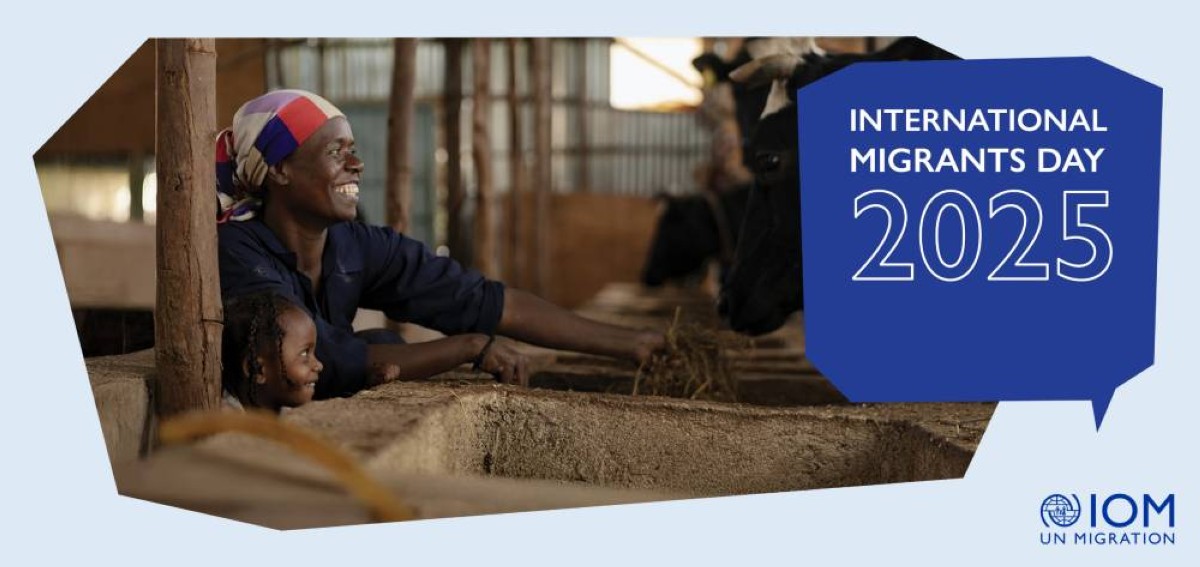
On International Migrants Day, Kuwait Times and IOM highlight expatriates whose work and values contribute to strengthening Kuwait’s development
As the world celebrates International Migrants Day, the spotlight turns to stories of resilience, hope and human progress. This year’s IOM theme, “My Great Story: Cultures and Development”, highlights how migration connects people, enriches cultures and drives innovation. Kuwait Times, in partnership with the International Organization for Migration (IOM), is featuring interviews with several foreign workers across Kuwait, sharing how their experiences have transformed lives and contributed to the country’s development.
Musthafa Hamza
When Musthafa Hamza left his hometown in Kerala more than four decades ago, he carried little more than a young man’s hope: To grow, provide and experience a world larger than the one he knew. He arrived in Kuwait seeking an opportunity, but what he ultimately built was something far greater than a career.
Today, after 43 years in the country he now calls his “second home”, Hamza’s story is no longer just about a migrant chasing a livelihood. It is about a man who saw the silent struggles of others, workers confused by unfamiliar laws, families broken by tragedy, people facing challenges, and chose to stand between them and despair.

Gertrude Acolatse Tetteh

Lizel Subialdea

Mark Gil Caparros

Musthafa Hamza
The most touching part of Hamza’s journey began with a moment of shock, discovering that some expatriates faced challenging circumstances simply because they had no guidance, no translator or no one to present their true case. “These were people who didn’t do anything wrong. They were victims of misunderstanding,” he told Kuwait Times.
Hamza could not look away. Without formal training, he began visiting authorities, presenting factual details, and personally advocating for each case. His quiet persistence led to the release and rehabilitation of several individuals. People who would have otherwise remained shadows in a system they did not understand.
For years, repatriating the bodies of deceased expatriates was a painful, complicated process, leaving families thousands of miles away in helpless grief. Hamza decided that grief should never be made heavier by bureaucracy. Working with sociocultural organizations, he helped streamline procedures and coordinate with authorities; ensuring loved ones were returned home swiftly and respectfully. To many families, he became a stranger who showed up at the darkest hour and left only after restoring dignity to those they had lost.
Professionally, Hamza rose at his job in a medical center, shaping it with the same values that defined him. His belief that healthcare should be accessible led him to introduce the region’s lowest consultation charges, a decision that many called bold, but he considered necessary. To expats, he offers a simple truth learned through experience: Respect the laws, live with goodwill, and Kuwait becomes one of the safest, most welcoming homes one could ask for.
Mark Gil Caparros
As for Mark Gil Caparros, who arrived in Kuwait in 2017, he carried with him a suitcase, a set of Filipino values shaped by compassion and service, and a quiet hope that he might make a difference. What he didn’t know was that Kuwait would give him something far greater in return, a story that would change him forever, one small child at a time.
Caparros, a Filipino US Board Certified Behavior Analyst and a PhD candidate in applied behavior analysis, has built his life around supporting children with special needs. As program director at a special needs services, he has spent years walking into therapy rooms filled with the unexpected tiny hands that do not yet reach out, eyes that avoid meeting his and voices that struggle to shape words. But for him, these rooms are full of possibility.
Among the many children Caparros has worked with, one little boy left a lasting imprint, so much so that he later inspired Caparros’ children’s book, “Nasser’s Wiggle Waggle Adventures”. Nasser came to therapy shy, hesitant and overwhelmed by the world around him. Communication was difficult; expressing feelings was even harder. But every day, he made the same small, joyful gesture — a gentle wiggle of his shoulders followed by an excited waggle of his hands whenever he understood something new. “That wiggle-waggle was his way of saying, I’m trying… I’m happy… I’m here,” Caparros said.
Day after day, Caparros watched Nasser’s tiny victories grow into meaningful breakthroughs. A sound became a word. A gesture became a sentence. A look turned into laughter. And through those moments, Caparros saw not just progress, but hope. He said, “That child reminded me why I am here. Why I chose this field. Why compassion must guide our work.”
Caparros’ work in Kuwait is shaped deeply by the values he carried from the Philippines: Empathy, humility and service to those who need it most. From underserved communities back home to therapy rooms in Kuwait, those values continue to guide him. His contribution extends beyond clinical support. He advocates for awareness, educates families and helps parents understand that with evidence-based intervention, children can grow in ways they never imagined.
He affirmed: “To support one child is to support an entire family,” highlighting Kuwait’s emphasis on close family bonds in weekend gatherings, shared meals and cultural traditions that mirror his own Filipino roots. Caparros is not only a therapist; he is an author whose stories travel beyond the therapy room. His message to others is simple but powerful: “Remember your ‘why’. Stay connected to your purpose.”
Lizel Subialdea
Lizel Subialdea arrived in Kuwait in 2009. She is the eldest of six siblings, looking for a chance to build a better life for herself and her siblings. To leave home not for adventure, but for family, became the defining moment of her story. It is the quiet beginning of a journey that shaped not only her career, but the woman she would become.
Kuwait became more than a workplace or a foreign land; it became the place where she slowly grew into herself. Working as a manager for more than 15 years, Subialdea said, “I didn’t just build my career here, I built myself, and the woman I am now is because of everything I went through in this place.”
Kuwait witnessed her loneliness, her homesickness and her doubts. Despite the distance, Subialdea never lost the values she grew up with: Respect and a deep love for family. She carried them into her workplace, sharing her culture in simple, authentic ways: Bringing homemade dishes, teaching colleagues’ phrases from her language and sharing stories of home.
And Kuwait, in return, gave her something she never expected: A new way of seeing life. “What stayed with me from Kuwaiti culture is the quiet strength people have here. It taught me to be more patient, more grounded, more intentional,” she said. With her background in psychology, Subialdea learned to understand emotions not just her own, but the people around her. When she returns home, she brings these lessons with her, saying: “I try to help my family and community see things with more patience and empathy. Even simple conversations become a way of bringing emotional awareness and support.”
She added: “My great story is a journey of growth, resilience and connection. Every challenge is a chance to grow, and every connection is a chance to understand someone’s story. Staying true to your roots while learning from others doesn’t just help you thrive, it helps everyone around you thrive too.”
Gertrude Acolatse Tetteh
Teacher Gertrude Acolatse Tetteh arrived in Kuwait 10 years ago, leaving behind her home in Ghana with a heart anchored in service and a quiet determination to grow. She said that Kuwait offered her more than professional growth; it offered a community in need of the very values she carried with her from Ghana, such as hospitality, hard work, respect and a deep belief in communal living.
One of her most touching contributions began with a single child, a student struggling with learning difficulties. The family could afford tutoring, but Tetteh saw something beyond financial need. She saw a chance to make a real difference. For three years, she offered free tutoring, week after week, patient and committed. Not for recognition, but because, as she often says: “Service is my way of honoring the blessings I’ve received.”
Her impact didn’t end there, when members of the Ghanaian community encountered immigration challenges, Tetteh collaborated with a global nonprofit organization, navigating complex procedures to restore their dignity and stability. Perhaps her most defining achievement is her role in forming the Ghanaian Union in Kuwait. Tetteh opens her home’s doors for others to understand Ghana through celebrations of Independence Day filled with drumming, dancing and shared meals moments where Kuwaitis and expatriates gather not just as guests, but as friends. She has even encouraged colleagues to visit Ghana, trusting that a true cultural exchange begins with firsthand experience.
Living in Kuwait has also shaped her, saying: “Kuwaiti culture has deeply influenced me. I have learned the importance of generosity, respect for religious values and the strong sense of family and community support. Their commitment to hospitality has inspired me to continue promoting unity, understanding and mutual respect within my own community.”
Her journey has built resilience, broadened her worldview and expanded her capacity for leadership. Whether guiding newcomers, supporting her family, or empowering her community back home. This year’s theme “My Great Story: Cultures and Development” feels almost written for her. Tetteh’s story is not about one culture influencing another, but about two cultures intertwining to create something richer. She concluded: “To expats I say embrace the journey. Stay true to your values. Support one another. And to Kuwait, thank you for your hospitality. We respect and appreciate your culture deeply.”
