

I grew up in Bethlehem with a simple Advent ritual.
Every Christmas season, I would light a white candle inside the Church of the Nativity – a small flame meant to symbolise hope, peace and the quiet expectation that Christ enters even the hardest places.
The candle was more than tradition. It was our way of saying that despite everything we endured, God had not abandoned Bethlehem.
This Advent, that ritual collided with a different reality.
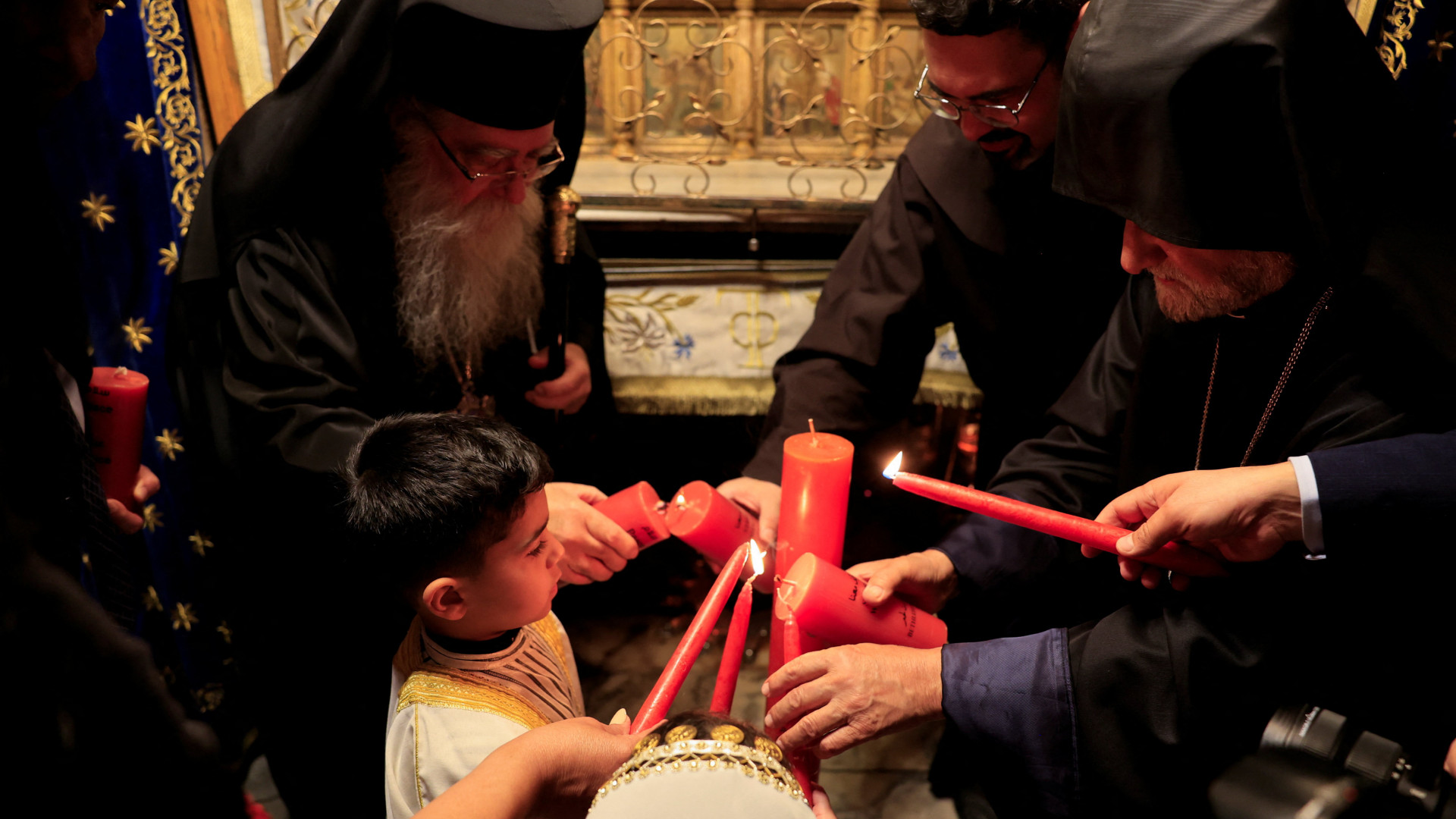
In the Grotto of the Nativity, two Palestinian children, Layna and Jivan, lit a red candle in place of the usual white one, launching the Red Candle campaign – an act of solidarity with suffering families in Bethlehem, Gaza and across Palestine.
New MEE newsletter: Jerusalem Dispatch
Sign up to get the latest insights and analysis on
Israel-Palestine, alongside Turkey Unpacked and other MEE newsletters
The moment was understated, almost hidden, but the symbolism was unmistakable: the world that sings about Bethlehem each December does not always see the place we know.
Some pastors have gone so far as to deny the geography of our biblical story.
One well-known evangelical leader told his millions of followers: “Jesus is the one born in Bethlehem… not Bethlehem of the West Bank, no, no such thing.” His message was unmistakable – acknowledging the modern Palestinian town somehow distorts the biblical narrative.
The world that sings about Bethlehem each December does not always see the place we know
And yet Bethlehem is not an abstraction. It is a real place with real families, real churches and a continuous Christian presence stretching back two millennia. It is where my relatives still live and where generations have prayed since the earliest centuries of the faith.
Erasing its contemporary identity is not only historically inaccurate but spiritually careless – a way of protecting an imagined Holy Land while ignoring the people who live there now.
This is the gap between the Bethlehem many imagine and the one we know and live.
A heavy Advent
This holiday season feels particularly heavy for me.
I am a Palestinian-American Christian who spends each Advent speaking in US churches. I stand before warm congregations and help lead them in “O Little Town of Bethlehem”, yet I cannot escape the fact that the Christian community of that little town is being erased little by little, year after year.

All Palestinian Christians want for Christmas is to return
Read More »
My ties to Bethlehem run deep.
My extended family lives in neighbourhoods where church bells ring alongside the anxiety of shrinking land and opportunity. My wife’s family is in Gaza, where many have survived war after war with almost nothing left to rebuild.
Advent, for us, is not only a season of anticipation – it is a season of contradiction. We sing about peace while praying that our relatives will live through the night.
This is the context into which those two children lit a red candle. And from that small gesture, something unexpected happened.
Within hours, churches in the US, Rome and Jerusalem joined them. A movement spread as ordinary Christians recognised the urgency of the moment.
A fading presence
The Red Candle initiative calls on Christians worldwide to see what is often unseen: the dwindling Christian presence in the land where Christianity began.
Bethlehem, Beit Sahour and Jerusalem still have Christian families who have preserved their faith through centuries of empire, displacement and political upheaval.
Follow Middle East Eye’s live coverage of Israel’s genocide in Gaza
But the land loss, economic hardship, and the trauma of conflict threaten their future today in ways many around the world scarcely realise.
For someone who grew up lighting a white candle, the red candle does not replace the old flame. It deepens it.
The white candle is hope; the red candle is truth. The white celebrates the promise of peace; the red names the violence that stands in its way. The white is what we pray for; the red is what we endure.
What makes this movement compelling is not its symbolism but its sincerity. It does not pretend that lighting a candle will change political realities. Rather, it insists that Christians around the world must no longer be passive observers of suffering, especially in the place they claim is central to their faith.
It reminds us that compassion is not a political statement; it is a moral one.
Two flames together
Each year, as I serve and minister between Bethlehem and American churches, the distance feels greater.
The Bethlehem of carols bears little resemblance to the Bethlehem my family knows, where life is shaped by restrictions, shrinking land and the quiet fear that one day the town might lose the very people who have carried its Christian identity for 2,000 years.
Bethlehem is more than a symbol. It is a fragile home to real people whose stories still matter
And yet, when I see Christians around the world lighting red candles this Advent, I feel something I have not felt in a long time: perhaps the global church is beginning to see the gap between the Bethlehem they imagine and the Bethlehem we live in, under occupation.
I still light a white candle with my family. It is a ritual of hope I refuse to abandon. But this year I am also lighting a red candle – for Bethlehem, for Gaza, for the families who stay and for those who no longer can.
The two flames together tell a fuller truth: that hope is real, but so is suffering; that faith can endure, but only if the world pays attention; that Bethlehem is more than a symbol. It is a fragile home to real people whose stories still matter.
And this year, that truth deserves to be seen.
The views expressed in this article belong to the author and do not necessarily reflect the editorial policy of Middle East Eye
