

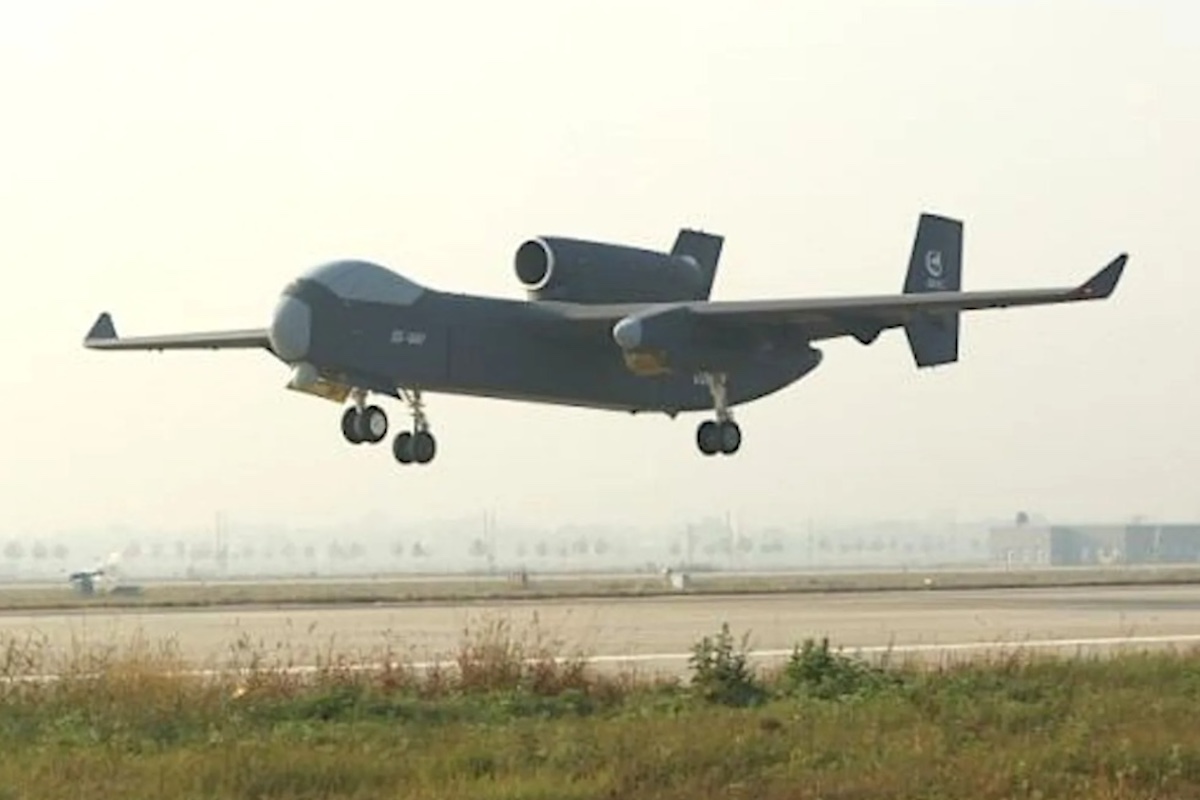
China’s first flight of the Jiutian drone carrier signals a shift toward massed, long-range swarm warfare that could expose Taiwan, US warships and vulnerable Pacific airbases to saturation attacks built on sheer numbers rather than stealth.
The test, conducted this month in Shaanxi Province, marked a significant step in China’s push toward airborne swarm warfare and long-range unmanned surveillance, according to multiple media reports.
The aircraft, first unveiled at the Zhuhai Airshow in November 2024, is designed to act as an airborne mothership capable of launching more than 100 smaller drones or loitering munitions during a single mission.
With a maximum take-off weight of about 16 tons, a 25-meter wingspan and an operational ceiling of 15,000 meters, Jiutian can remain airborne for roughly 12 hours and reach targets up to 7,000 kilometers away, those reports said.
Chinese military commentators say this allows the drone to deliver saturation attacks, conduct intelligence, surveillance and reconnaissance (ISR), and support electronic warfare by overwhelming adversary air defenses through numbers and not just stealth.
Western defense analysts describe the platform as a rare example of a high-altitude, long-endurance unmanned aerial vehicle (UAV) purpose-built for swarm deployment, beyond the capacity of US systems such as the Global Hawk or MQ-9 Reaper attack drones.
Chinese sources also stress the Jiutian’s dual-use roles, including disaster relief, logistics and communications support, underscoring its broader strategy of integrating civilian and military drone development amid rising regional tensions.
Timothy Ditter and Eleanor Harvey mention in an October 2025 CNA report that People’s Liberation Army (PLA) writings from 2020 to 2024 increasingly frame autonomous drone swarms as a key enabler for a Taiwan invasion or blockade.
Ditter and Harvey note that PLA analysts envision swarms being deployed from land, sea and air platforms as the vanguard of amphibious assault operations, conducting early warning, ISR, electronic warfare, deception, and suicide attacks to suppress Taiwan’s air defenses and radar systems.
They also state that PLA exercises since 2021 have used drone swarms as the first wave in cross-strait island-seizure drills, reflecting a shift from theory to experimentation.
Beyond overwhelming Taiwan’s defenses, Kristopher Thornburg mentions in a December 2022 Proceedings article that drone swarms threaten US surface ships by attacking from multiple axes, saturating defensive systems and exploiting the limited engagement capacity of traditional shipboard weapons.
Thornburg notes that their small size, low radar signatures and autonomous coordination allow swarms to confuse sensors and that simultaneous, multi-axis threats can overwhelm command-and-control decision-making.
He notes that when equipped with explosives or used for targeting support, swarms can disable radars, overwhelm close‑in defenses and create openings for follow‑on strikes, making them a disruptive and disproportionately effective tool against even well‑armed vessels.
Apart from targeting Taiwan’s defenses along with US and allied warships, China’s drone swarms can also threaten forward-deployed US and allied forces within the First Island Chain.
As noted by Stacie Pettyjohn and Molly Campbell in a September 2025 report for the Center for a New American Security (CNAS), US forces based at Yonaguni in Japan and Mindanao in the Philippines face serious but different vulnerabilities to drone swarm attacks.
In a series of tabletop exercises (TTXs), Pettyjohn and Campbell show that PLA forces used autonomous and semi-autonomous drone swarms to target US Marine Littoral Regiment units on Yonaguni and dispersed US Air Force Agile Combat Employment (ACE) sites on Mindanao.
They point out that Yonaguni’s small size enabled overlapping defenses and mutual support, allowing US forces to defeat early attacks despite proximity to China.
In contrast, Pettyjohn and Campbell show that Mindanao’s widely dispersed airfields—roughly 160 kilometers apart—precluded mutual support, allowing Chinese swarms to overwhelm limited counter-drone coverage and expose fuel stores, runways and parked aircraft to saturation attacks.
While small swarming drones might not have the range for long-distance strikes on US airbases in the Pacific, whether launched from bases in mainland China or outposts in the South China Sea, deploying them from a mothership like Jiutian could allow them to threaten crucial facilities at Guam and beyond.
US bombers on the ground may be vulnerable to a swarming drone attack, a risk underscored by Ukraine’s audacious July 2025 Operation Spiderweb, wherein in drones covertly smuggled inside Russia destroyed a substantial portion of its strategic bomber fleet in a swarm attack.
As Alexander Aznavoorian mentions in an October 2025 article for the Pericles Institute, during the buildup of forces for strikes against Iran’s nuclear program earlier this year, US B-2 and B-52 bombers were parked out in the open at Diego Garcia in the Indian Ocean, despite the threat of an Iranian drone attack.
Aznavoorian notes that the success of Operation Spiderweb was mainly due to Russia parking its strategic bombers out in the open instead of under protective shelters.
The lack of US-protected aircraft shelters could be decisive in a Pacific war with China. Thomas Shugart III and Timothy Walton note in a January 2025 Hudson Institute report that US and allied air bases across the Pacific suffer from a severe lack of hardened aircraft shelters, leaving aircraft highly vulnerable to Chinese precision strikes.
The writers note that while China has more than doubled its inventory to over 3,000 shelters since the early 2010s, US forces within 1,800 kilometers of the Taiwan Strait have added only a handful, with many bases—especially in Guam, the Marianas, Australia and the Philippines—having zero hardened shelters. They caution that such asymmetry makes US aircraft far easier to destroy on the ground and risks incentivizing a Chinese first strike.
Sean Zeigler and other writers in a June 2025 RAND report note that the US has taken incremental steps to improve airbase defense, such as increasing investment in active defenses, adopting the ACE strategy to disperse aircraft across multiple locations and increasing funding for passive defenses.
However, the writers point out that improvements remain insufficient relative to China’s rising threat. They say that spending on hardening and military construction has lagged for years, leaving aircraft and infrastructure exposed.
Other challenges highlighted by the writers include limited interceptor missile inventories, bureaucratic delays, host-nation basing constraints and continuing shortfalls in defenses against cruise missiles and unmanned systems.
Jiutian underscores how China is betting that cheap, mass and airborne swarms can offset US technological advantages, turning exposed ships and airbases into the weak link of American power projection.
Unless the US accelerates base hardening, aircraft dispersal and counter-drone defenses, the next Pacific fight may hinge less on who flies the most advanced aircraft than on who can keep them safe on the ground.
