

When Storm Byron first appeared on weather maps, Israelis were inundated with safety instructions: secure your windows, park cars away from trees, have emergency numbers at hand.
For over a week, the Israeli media’s main preoccupation was forecasting how much rain Tel Aviv might see and whether the country’s infrastructure can handle it.
Municipalities sent private texts advising residents on how to stay safe. Businesses closed. People rushed to supermarkets.
This is how a functioning society prepares for bad weather.
The storm was a challenge, but it is manageable for those with homes, drainage systems and functioning state services. But under the very same skies, in the besieged Gaza Strip, the forecast was a death sentence.
New MEE newsletter: Jerusalem Dispatch
Sign up to get the latest insights and analysis on
Israel-Palestine, alongside Turkey Unpacked and other MEE newsletters
Storm Byron began lashing Gaza on Wednesday with torrential rain and flooding continuing into Thursday, and is expected to last through the week.
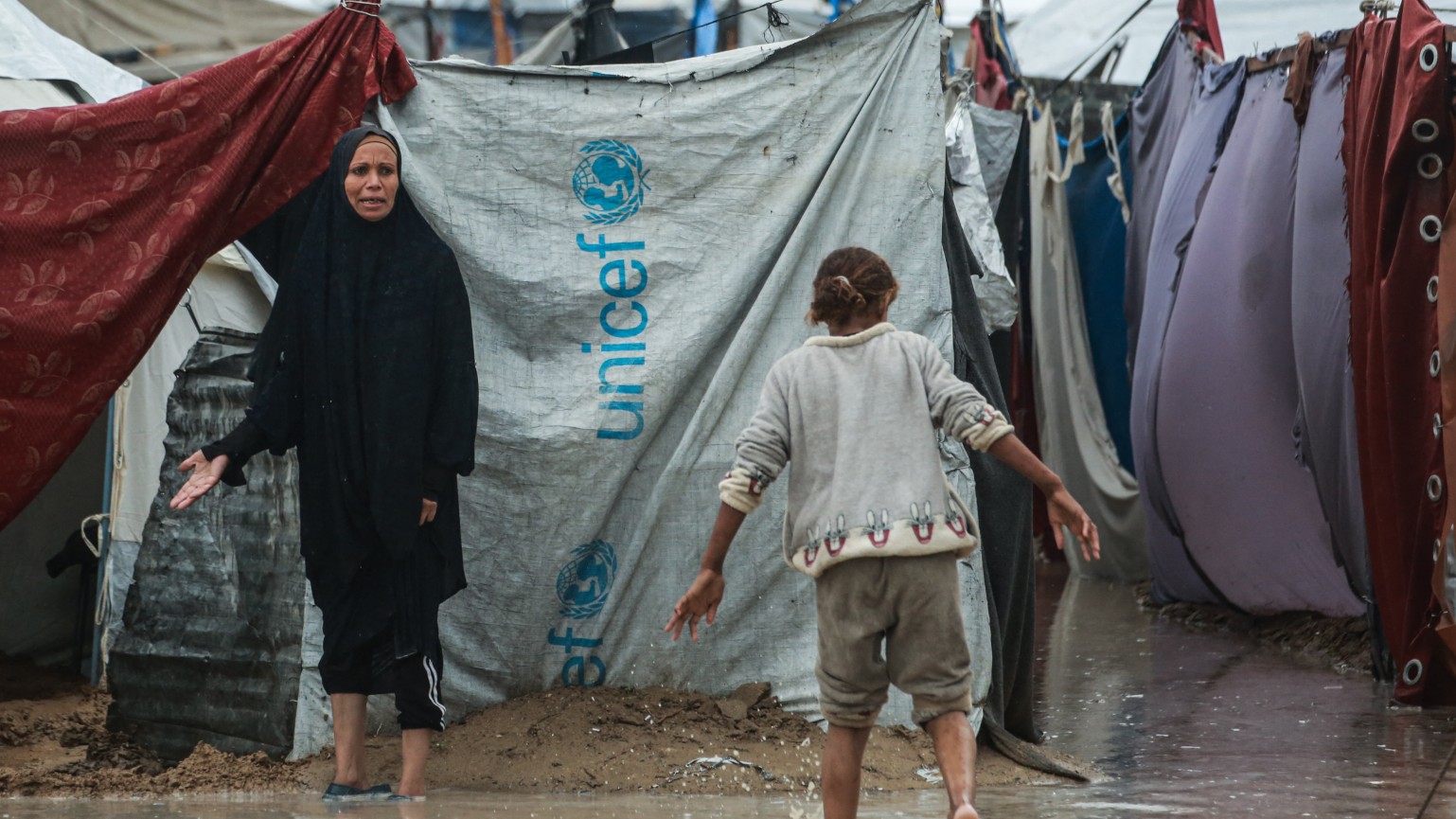
Hundreds of thousands of people displaced by Israel’s ongoing genocidal war were huddling in tent camps that offer no protection from the elements, with many already swamped due to the mass bombing of sewage and drainage systems.
Two months into the so-called “ceasefire”, this vulnerable population faces the worst of winter and the rapid spread of disease, with literally nowhere dry to shelter.
Almost immediately after the rains began, footage emerged of tents flooding, canvas ripping, and families scrambling through knee-deep water
Moreover, Israel is still blocking aid. More than 6,500 trucks are waiting at the crossings to be let into Gaza with essential winter supplies, including tents, blankets, warm clothing and hygiene materials. As they wait, children are going barefoot and wearing summer clothes in the freezing cold.
In total, nearly two million Palestinians are sheltering in flimsy tents or makeshift structures that can collapse under a downpour, after years of bombardment and the near-total destruction of housing, sanitation and drainage systems.
Almost immediately after the rains began, footage emerged of tents flooding, canvas ripping, and families scrambling through knee-deep water, trying to salvage what little they had left.
Tens of thousands of displaced Palestinians, already stripped of their homes by war and blockade, found themselves submerged under the storm.
Calls to civil defence teams came in from across the Strip as tents filled with water, leaving people with one desperate option: flee to slightly drier ground, if they can find any.
Forgotten by the world
The storm did not care about ceasefires, negotiations or humanitarian pledges. It revealed the grotesque inequality in who receives protection and who is abandoned.
World leaders and the international community continue to look away and abandon the people of Gaza.
Follow Middle East Eye’s live coverage of Israel’s genocide in Gaza
For Palestinians like 19-year-old Amro Akram, the storm was not simply another hardship; it was a reminder that the world had forgotten them.
Displaced from their home in Khuza’a, in Khan Younis, earlier this year, his family had already endured destruction, displacement and hunger.
When they fled after their home was bombed, they did not bring winter clothes, he told me. With no proper shelter, their flimsy tent collapsed when Byron hit.
“Our tent sank and was torn apart by the wind,” he said, his voice shaking. “We pray that the rain stops.”
Sharing one blanket between siblings, with no chairs, no mattresses and no warmth – this is not survival – it is abandonment.
Across Gaza, hundreds of thousands of people are enduring similar or worse conditions.
With no functional drainage lines or sewage systems, floodwaters carry human excrement into the very spaces people are forced to call home.
Humanitarian officials warn that this risks outbreaks of disease and could lead to death from hypothermia and water-borne illness.
A few days ago, Moain Hamo, a young man, died after falling while trying to seal his shattered windows with plastic and nylon to keep his family warm. His name never appeared in the news, and no one mentioned him.
Israelis mock Gaza suffering
Amid this devastation, many Israeli media commentators have openly celebrated the storm’s impact on Gaza.
A panellist on Channel 14 said he did not mind if tents in Gaza were destroyed or if Palestinians were once again displaced. He referred to the storm as a “cleanup” rather than a humanitarian catastrophe.
“I don’t think there will be a single tent left in place on Friday morning,” he said, before adding, “And I don’t have a problem that people will not be there either.

An hour from Gaza, Israelis sip coffee as genocide rages
Read More »
“What’s happening right now is a cleanup. God gave them the punishment, and now he’s cleaning the Strip with the water a bit.”
Such views do not exist in a vacuum. They reflect a broader moral collapse in how the suffering of Palestinian civilians is perceived, tolerated and trivialised.
As the rain continues, the consequences are now visible: flooded shelters, ruined food and possessions, and despair spreading among families whose resources were already spent on mere survival.
The health implications will unfold over weeks and months. Children already weakened by malnutrition and disease stand at even greater risk.
The storm hit, but the collapse of humanitarian protection in Gaza has been years in the making. It is the culmination of prolonged war, a crushing siege and failed international responses.
Now they suffer for simply being human in a place marked “disposable” by the policies and indifference of powerful states.
To the outside world, storms come and go. Infrastructure mostly holds. Lives are disrupted; rarely are they destroyed. But for Gaza, Byron has become a catastrophic chapter in a long story of imposed isolation.
Storm Byron has exposed the moral bankruptcy of a world that allows a people to drown under the same storm others prepare for with ease.
The views expressed in this article belong to the author and do not necessarily reflect the editorial policy of Middle East Eye.
