

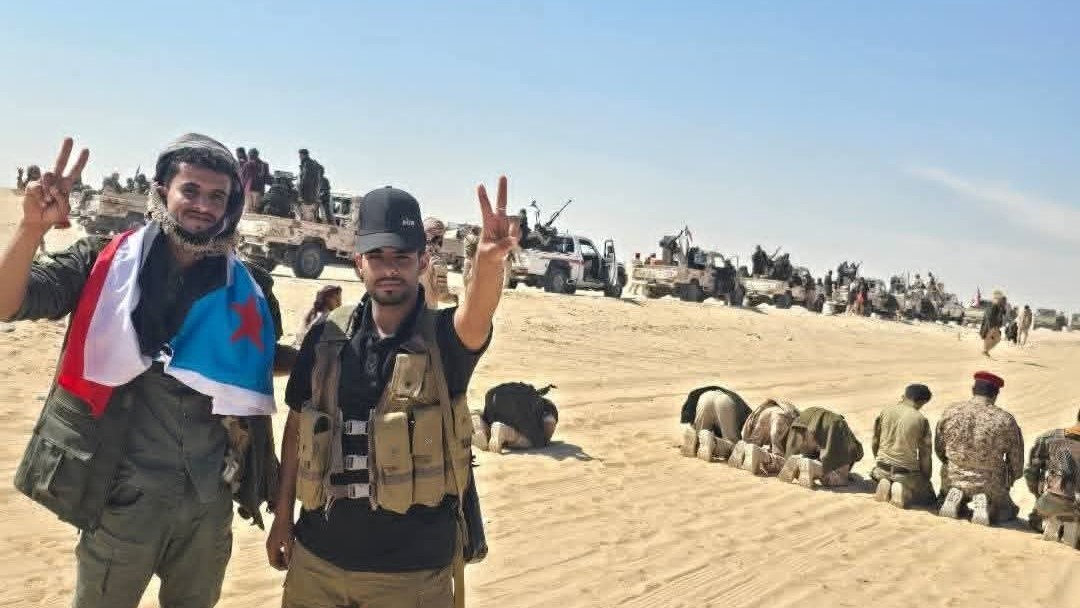
The flag of South Yemen is being hoisted above buildings and roads after the Southern Transitional Council (STC), a UAE-backed separatist movement, made huge advances in Yemen’s southeast.
In recent days, the STC launched a military offensive dubbed “The Promising Future” in Hadhramaut, seizing control of Seiyun, one of the largest cities in the region.
The Hadrami Elite Forces, the STC-aligned forces leading the campaign, took over Seiyun’s presidential palace and its international airport on Wednesday.
Since then, it has effectively taken control of all of Hadhramaut.
Sheikh Amr bin Habrish, the leader of the Saudi-backed Hadramout Tribal Alliance, had earlier this week spoken out against the STC’s advances and its overarching goal of independence for southern Yemen.
New MEE newsletter: Jerusalem Dispatch
Sign up to get the latest insights and analysis on
Israel-Palestine, alongside Turkey Unpacked and other MEE newsletters
As a pre-emptive move, his forces seized control of PetroMasila, Yemen’s largest oil company based in Hadhramaut, forcing production to cease earlier this week.

Yemen’s UAE-backed STC seizes control of city in Hadhramaut offensive
Read More »
But in the early hours of Thursday morning, the Hadrami Elite Forces took control of the facility and all of its protection points, forcing Habrish’s men to retreat.
Hadhramaut makes up about a third of Yemen’s territory, and holds 80 percent of the country’s modest oil reserves.
There had been fears of a rare confrontation between Saudi- and UAE-backed forces, after Habrish earlier this week called for Saudi help and vowed to fight against “foreign or non-local military presence” in Hadramout.
However, the tribal alliance agreed to withdraw from oil facilities and end all escalations in the area, in an agreement supervised by Saudi Arabia.
There was pockets of fighting, with at least four STC-aligned troops killed by Habrish’s men.
Amr al-Bidh, a senior official in the STC’s foreign ministry, said Habrish’s troops had been detained, while the leader himself “ran away”.
Southern flag re-emerges after decades
Videos circulating on social media showed people taking down Yemen flags and replacing them with the southern flag.
Bidh told Middle East Eye during a media briefing that the raising of the southern flag was “expression of the people”.
“It’s an expression of the people: that’s what they want. They are aligned with this project,” he said.
He added that the STC would not forcibly impose independence, but would follow “the will of the people”.
The historic South Yemen flag – which features a light blue chevron and a red star – was raised at the Shahn border crossing with Oman, reportedly for the first time since 1990.
The red star in the flag originally represented the Yemeni Socialist Party (which spawned from the National Front), a Marxist-Leninist movement that was the sole legal political party in the People’s Republic of Southern Yemen.
South Yemen was an independent country following British withdrawal in November 1967, until Yemeni unification in 1990.
Following the Yemeni war and the takeover of the capital Sanaa and other areas in the north by the Houthis in 2014, the Aden-based STC – which advocates for southern independence – has emerged as a key player among anti-Houthi elements.
‘Haven for terrorism’
Southern Yemen has for years been overseen by the Presidential Leadership Council (PLC) – an executive government body that initially had both Saudi and Emirati support.
However, the body was riddled with internal disagreements and jostling. The STC’s moves over the past few days may prove decisive in taking effective control of the PLC.
Bidh said that “nothing has changed” in the PLC. “All the government is in Aden. So we are working, business as usual,” he said.
Footage online purported to show armed men in al-Mahra, the most eastern province of the country, replacing Yemeni flags with southern ones.
Bidh said that the STC had not moved into al-Mahra, and that footage of troops hoisting southern flags in the eastern governorate was of existing regional forces there expressing support for independence.
For over three decades, he added, southern independence movements had advocated for the return of al-Mahra to a southern Arabian state.

Yemen’s southern secessionists face backlash over talk of ties with Israel
Read More »
“Our aim since 31 years [has been] to liberate the whole of the land of South Arabia, which is from Bab al-Mandeb to al-Mahra. That’s our objective.”
According to Mohammed al-Basha, a risk analyst and expert on Yemen, the STC has taken control of al-Abr region in Hadhramaut and now “effectively commands all supply routes, logistical corridors, and ground lines of communication” to PLC-aligned army regional commands based in Marib.
“The loss of Al-‘Abr removes the final major access point linking these commands to the east and South Yemen,” Basha wrote on X.
In a statement, the STC’s foreign ministry said that Hadhramaut had become a “haven for terrorism” and a hotbed “for the activity of extremist organisations such as Isis and al-Qaeda”.
It said that its campaign followed the “exhaustion of all options” in recent years to stabilise the area.
Rich Tedd, a geopolitical analyst, reported this week that the STC had been pictured using UAE-supplied military equipment, including Chinese 155mm AH-4 howitzers – the same systems the Emiratis also reportedly supplied to Sudan’s Rapid Support Forces.
Armoured vehicles made in the UAE have also been identified as being driven by STC-aligned forces.
MEE reported in October that facilities in two islands administered by the STC, Abd al-Kuri and Samhah, formed part of a network of bases around the Gulf of Aden under the influence of the Emirates.
