

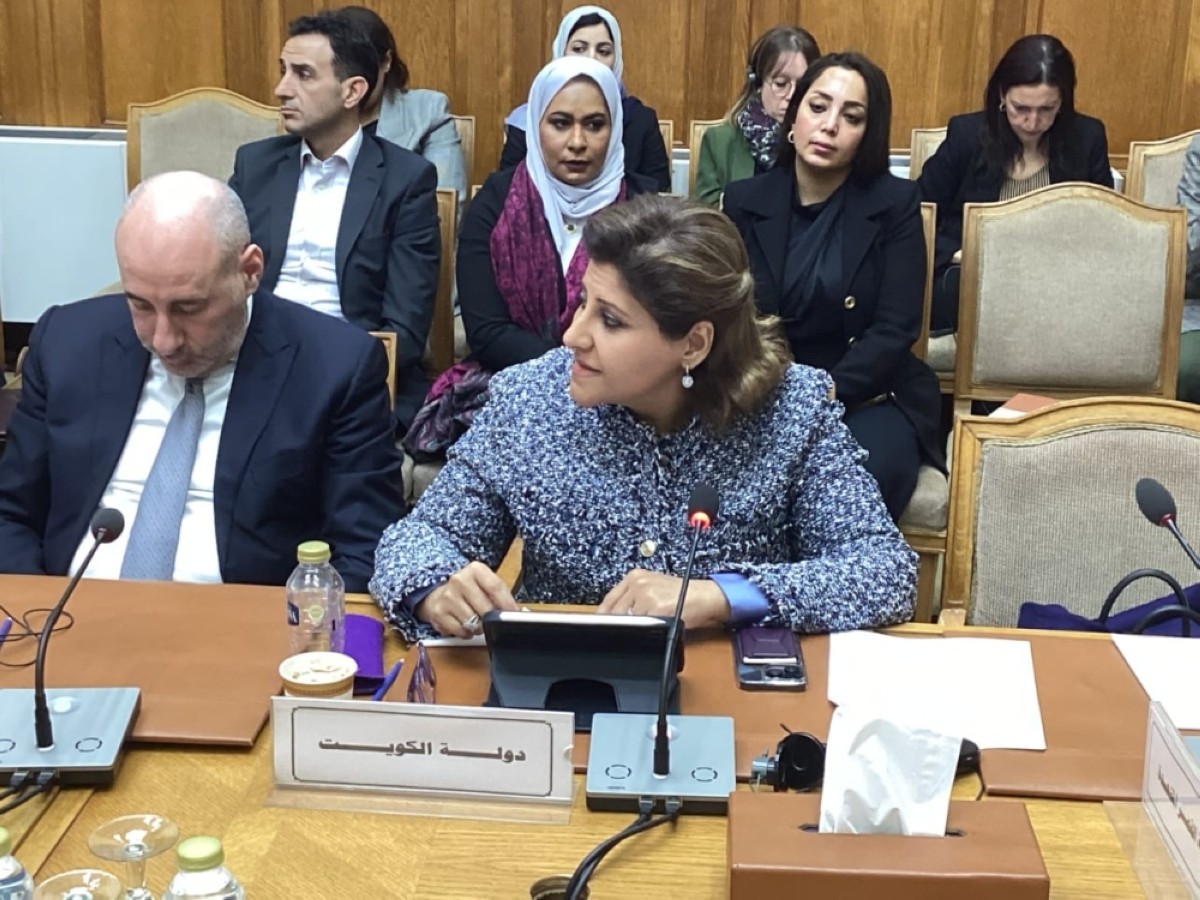
KUWAIT: Kuwait on Tuesday reiterated its firm commitment to the principles of international humanitarian law and to regional and global efforts aimed at strengthening human rights protection during armed conflicts. The statement was delivered by Assistant Foreign Minister for Human Rights Affairs, Sheikha Jawaher Ibrahim Al-Sabah, on behalf of the Minister of Justice and Chair of the National Committee for International Humanitarian Law, during the 13th meeting of Arab national committees at the Arab League.
Sheikha Jawaher highlighted Kuwait’s unwavering faith in international cooperation, particularly in human rights, noting that Kuwait’s accession to the four 1949 Geneva Conventions in 1967 reflects its early and enduring commitment to international obligations. She called for enhanced cooperation among states and regional bodies through the exchange of expertise and memoranda of understanding, emphasizing the need for shared frameworks to implement humanitarian law amid accelerating global crises.
She praised Kuwait’s leading role on issues relating to missing persons in armed conflicts, citing close collaboration with the International Committee of the Red Cross (ICRC) that contributed to the adoption of UN Security Council Resolution 2474 (2019) during Kuwait’s tenure as a non-permanent member. Sheikha Jawaher also highlighted Kuwait’s recent legal developments, including Decree-Law No. 134/2025 on protecting the Red Crescent and Red Cross emblems, Decree-Law No. 154/2025 on missing persons, and Decree-Law No. 156/2025 on international crimes. She noted ongoing work to study legislation for the protection of cultural property in line with humanitarian law standards. She concluded by urging states to fulfill their obligations under the Geneva Conventions and relevant UN resolutions, emphasizing that humanitarian law provides a critical framework for accountability, reduces suffering and promotes peace.

Sheikha Jawaher Al-Sabah is shown during the opening of the Ministry of Foreign Affairs workshop.- KUNA photos
Elderly rights
In a related development, Assistant Foreign Minister for Human Rights, Ambassador Sheikha Jawaher Ibrahim Al-Duaij Al-Sabah, on Tuesday stressed the importance of upholding human dignity and ensuring justice and equality for all, with particular focus on the elderly, describing it as a national priority in Kuwait’s human rights policies. Sheikha Jawaher Al-Sabah made the remarks in a video address at the opening of a three-day workshop organized by the Ministry of Foreign Affairs in collaboration with the United Nations Economic and Social Commission for Western Asia (ESCWA) and the Kuwaiti Ministry of Social Affairs. The workshop, titled “The Rights and Priorities of the Elderly in the State of Kuwait,” coincides annually with the Gulf Declaration on Human Rights (December 9) and the Universal Declaration of Human Rights (December 10).
She highlighted that the workshop underscores Kuwait’s commitment to human rights for all age groups, noting that dignified and active aging is an integral part of a broader rights framework that guarantees equality and justice for all citizens. The event provides a national platform to discuss public policy priorities for older persons and review the current draft of the National Strategy.
The initiative aims to align national priorities with Kuwait Vision 2035, the 2030 Sustainable Development Goals, and international human rights principles, fostering a unified institutional approach to protecting the elderly. Sheikha Jawaher Al-Sabah emphasized that the workshop will strengthen coordination among government entities, civil society, and international organizations to develop inclusive policies ensuring a dignified, active and secure old age.
She noted that Kuwait values the pivotal role of older persons in society and recognizes their contributions across generations. This commitment is rooted in the country’s dedication to human dignity and social justice, as enshrined in Article 11 of the Constitution, and supported by Law No. 18 of 2016 on the Rights of the Elderly, which provides a comprehensive framework for their care, protection and empowerment. The workshop brings together international experts from ESCWA and representatives from Kuwaiti government institutions, aiming to equip participants with the skills to promote and safeguard elderly rights, advance equality, and contribute to a prosperous and sustainable society. — KUNA
