

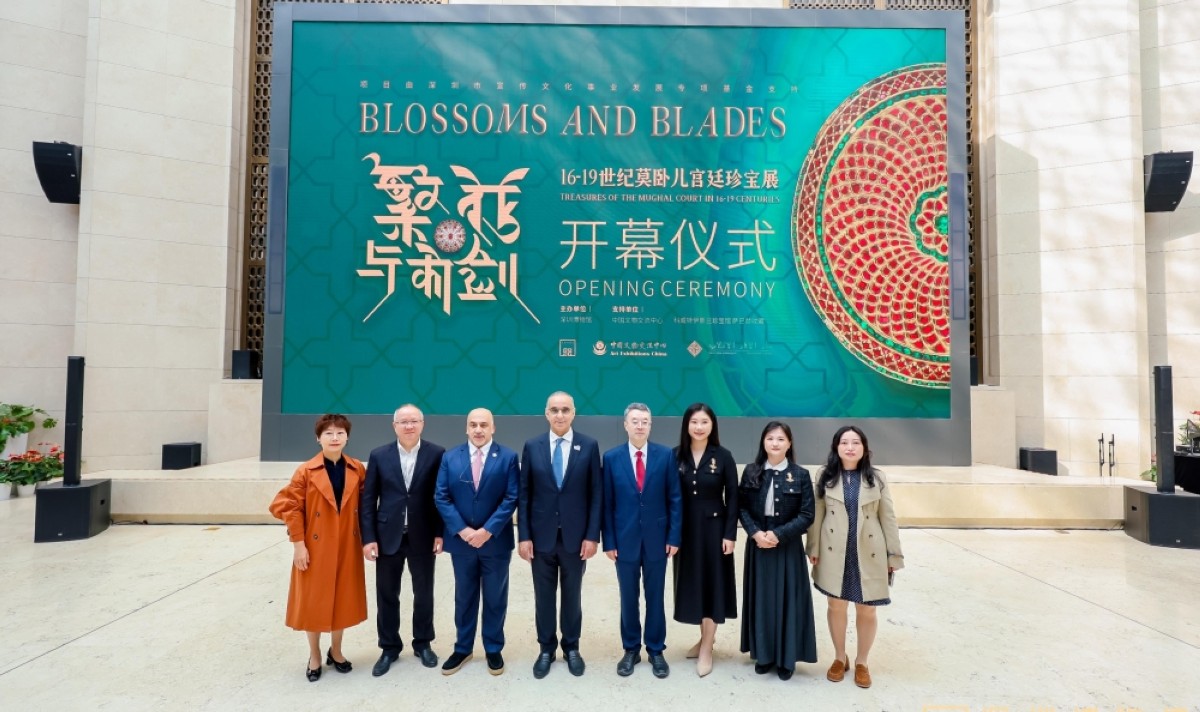
SHENZHEN: Kuwait, in cooperation with China, inaugurated the “Blossoms and Blades” exhibition on Friday in the southern Chinese city of Shenzhen. The exhibition features around 143 artistic masterpieces from the Al-Sabah archaeological collection, showcased in Shenzhen for the first time as part of a new phase of global cultural cooperation. Titled “Blossoms and Blades: Treasures of the Mughal Court from the 16th to the 19th Century,” the event was organized jointly by the National Council for Culture, Arts and Letters (NCCAL) of Kuwait and the Shenzhen Museum, under the supervision of the Dar Al-Athar Al-Islamiyyah – Al-Sabah Collection, a statement by the institution obtained by KUNA said.
Representing Minister of Information and Culture and Minister of State for Youth Affairs Abdulrahman Al-Mutairi, NCCAL Chairman Dr Mohammad Al-Jassar conveyed the minister’s greetings. He noted that the exhibition reflects the vision of the late Sheikh Nasser Sabah Al-Ahmad Al-Sabah and his wife Sheikha Hessa Sabah Al-Salem Al-Sabah, general supervisor of Dar Al-Athar Al-Islamiyyah.
The ceremony was attended by Kuwait’s Consul in Guangzhou, Abdullah Turki Al-Turki, and other officials. Dr Al-Jassar highlighted that the exhibition extends longstanding cultural cooperation between Kuwait and China, referencing the 2024 conference Distances Apart, Relations Close: The Silk Road as a Bond Between Two Worlds. He added that this year carries special significance as Kuwait celebrates its designation as the Arab Capital of Culture and Media.
The opening ceremony began with a VIP reception for Kuwait’s delegation, followed by a welcome speech from Cai Huiyao, Deputy Director of the Shenzhen Museum. Cai expressed pride in hosting the exhibition and underscored the importance of strengthening cultural ties between Kuwait and China. He emphasized that the Chinese audience is eager to explore Mughal and Islamic heritage through some of the world’s most distinguished artistic works.
The exhibition features a curated selection from the Al-Sabah Collection, highlighting the grandeur of the Mughal court and Indian arts across four centuries. The display includes intricately decorated daggers and weapons adorned with precious stones such as emeralds, rubies, and diamonds—including a notable 17th-century katar dagger—alongside crystal vessels, floral-motif artifacts, and royal jewelry that reflect the opulence and craftsmanship of Mughal artisans. — KUNA
