

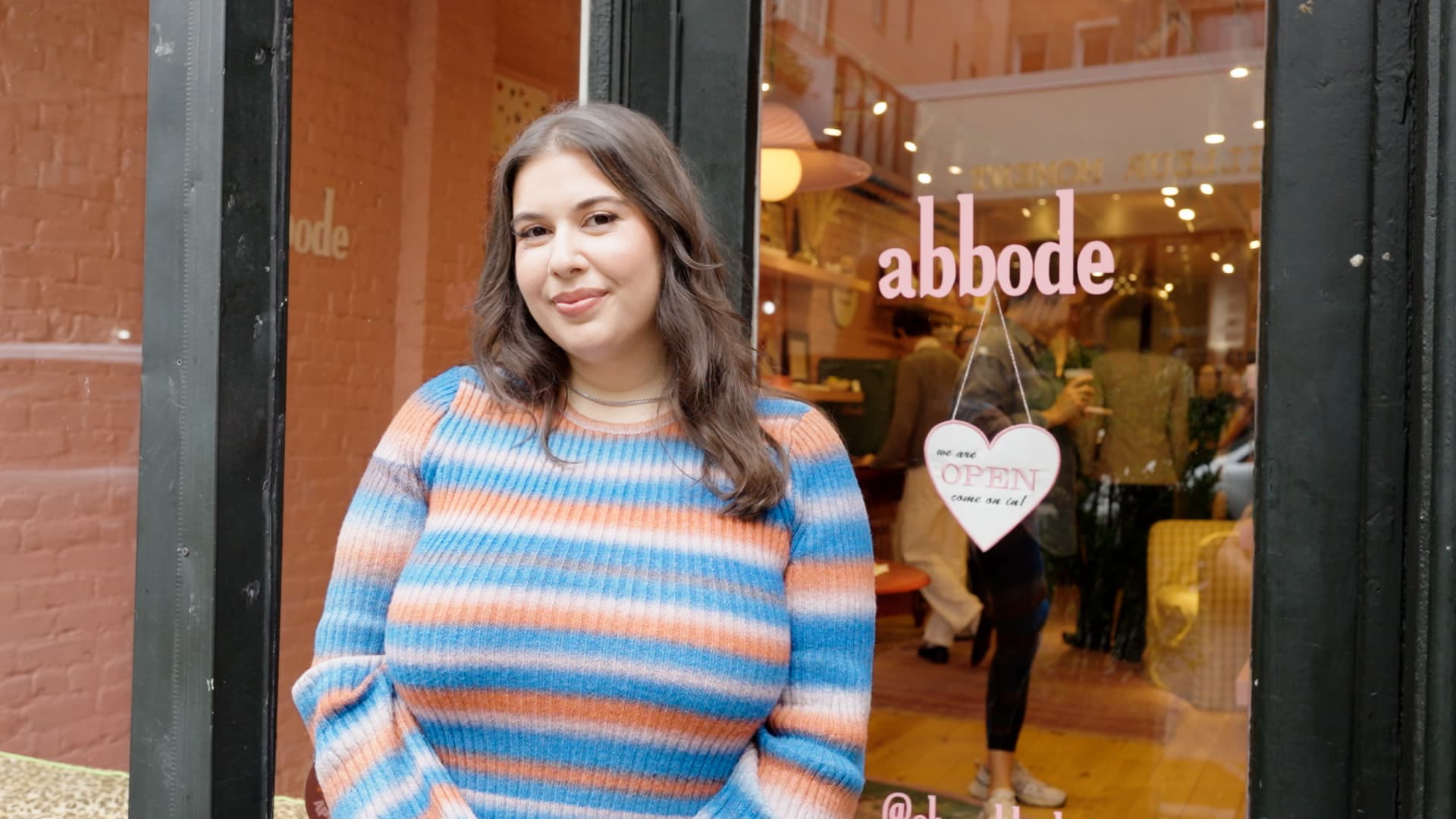
For a year, the secret to Abby Price’s success sat covered in dust in her shop’s basement.
Price started her company Abbode as a graduate student at Parsons School of Design, selling dried floral arrangements to New York locals on Facebook in 2019. By March 2022, she sold bouquets and home decor from a storefront she rented in the city’s Nolita neighborhood — and had enough cashflow to finance a $15,000 embroidery machine, which Price bought “on a total whim,” she says.
Without the expertise or space to actually operate the 100-pound machine, she stored it in her shop’s basement. But when consumer spending dropped after the ensuing holiday shopping season, Abbode started to struggle — until Price hosted a two-day embroidery event at her store in March 2023.
On the event’s first day, Abbode brought in five times the sales of the previous Saturday, according to documents reviewed by CNBC Make It. “That weekend, I knew I had something special on my hands. I knew that nothing was going to be the same,” says Price, the company’s 29-year-old CEO and co-owner. “I was just really early [to a trend].”
DON’T MISS: Exclusive Black Friday discounts on courses to help you earn more money and get ahead at work
Over the next year, Abbode shifted its business to offer customizable embroidered products and embroidery services, both in-store and online. It brought in $1.59 million in total 2024 sales, up from $719,000 the year prior, documents show. The company projects it’ll end 2025 with $4 million in annual sales, as of Sept. 30.
Events are responsible for roughly 25% of that revenue, documents show. Abbode has hosted pop-ups around the world — in England, Spain and Italy — with brands like L.L. Bean, Ritz Carlton and Charlotte Tilbury. Pop star Sabrina Carpenter wore an Abbode-customized yellow T-shirt with red stitching that read, “Live From New York,” during her Oct. 18 performance on NBC’s “Saturday Night Live.”
Despite its high sales, Abbode is essentially operating at breakeven levels — it’s profitable by a small margin — says co-owner and COO Daniel Kwak. The company is prioritizing brand recognition and expanding its revenue streams before trying to grow its profitability, he says.
Here’s how a once-barely used embroidery machine changed Price’s life, and how she hopes to make Abbode a household name:
An unsteady home decor business
Price’s initial decision to turn her Facebook-native business into a New York storefront was simple. Rents were low during the Covid-19 pandemic, and she could spend $20,000 — between her savings and a gift from her parents — on a security deposit and a couple months’ rent to test the waters of running her own retail shop, she says.
When her six-month lease expired, she doubled down — moving into Abbode’s current location, a space roughly twice the size and monthly rent, in November 2021. She took on $60,000 in loans from friends and family to cover the expansion, and saw quick returns, she says.
Amid the holiday season, customers packed the buzzy retail neighborhood’s streets and bought enough of Abodde’s home décor to push the company’s sales to $60,000 per month, says Price.
Abbode founder and CEO Abby Price on opening day at the company’s first brick-and-mortar location. Her boyfriend bought her giant scissors off Amazon to commemorate the occasion, she says.
Courtesy of Abby Price
Feeling financially secure, Price splurged on the embroidery machine, paying off its financing in $1,000 monthly payments, she says.
Then, the holidays ended. Abbode’s sales leveled off at roughly $45,000 per month in June 2022, Price estimates. “As the business grew, I feel like the problems also grew,” she says. “I was constantly investing in things, more employees, more inventory, this embroidery machine. It all just sort of started to catch up with me.”
The ebb of sales caused Price uncharacteristic anxiety, and she cried in the store’s bathroom on its second anniversary, she says: “Not many people came. I was feeling so overwhelmed and stressed because I knew something had to change here.”
A business-altering shift to embroidery
In March 2023, the embroidery machine needed to be professionally serviced, to ensure it was working properly — so Price and her team hauled it out of the basement. To make the physical effort worthwhile, she hosted a pop-up event where customers could buy Abbode items and get them embroidered for free, she says.
Within a few hours, flurries of yellow sticky notes covered the checkout counter, documenting the high volume of custom embroidery requests. It took weeks to get through all of the orders, Price says. She started buying more machines and training employees to use them, and by the end of the year, embroidery was responsible for 50% of the store’s revenue, she says.
Abbode co-owner Daniel Kwak, left, says the “shared vision and complimentary skills” between him and Price helps make the business successful.
CNBC Make It
Kwak, a friend of Price’s boyfriend, had worked for Abbode part-time since 2022 and transitioned into full-time work and co-ownership of the company starting in late 2023. He helped convince Price to shift Abbode fully into embroidery, he says. Specifically, he saw potential with more limited-time embroidery events, he says — and as Abbode hosted more of them over the following year, including some in partnership with other brands, its revenue doubled.
Price and Kwak rented a second location, a $5,000 per month office in Chinatown, in July 2024 to house its machines and embroiderers, and take on more orders. That September, L.L. Bean cold-emailed her to ask if she would host an L.L. Bean a pop-up event to sell Abbode-customized Boat and Tote bags. Customers waited in line for up to four hours, and the partnership brought in over $100,000 in sales that weekend, says Price.
The company now has 10 embroidery machines and 25 employees, a mix of full-time and contract. It partnered with a fulfillment center to complete some of its embroidery projects offsite earlier in 2025, Price says.
The right place, the right time
Customization-focused businesses — like embroidery, needlepoint or knitting services — all have the potential to succeed right now, says Marni Shapiro, a co-founder and managing partner of research and consulting firm The Retail Tracker.
Nostalgia thrives in uncertain political and economic climates, Shapiro says, and businesses offering hands-on services can be attractive to shoppers who may feel exhausted by their phones and the rise of artificial intelligence.
Personalization searches are rising on Etsy, for example: Searches for personalized clothing have doubled over the last three months, and searches for personalized decor are up 240% compared to the same time period in 2024, according to the platform.
Etsy sellers aren’t Abbode’s competition, Price notes, because they can’t offer in-person experiences. Instead, she compares Abbode to medium-sized brands like Stoney Clover Lane — which has seven storefronts mostly along the East Coast — or Mark and Graham, which is owned by home goods conglomerate Williams-Sonoma.
Price defines her target customer — “the Abbode girl” — as a thoughtful gift-giver who “knows what’s in” and cares about “the little things.”
CNBC Make It
Abbode isn’t currently as large as those brands. But if demand keeps growing, Abbode will be able to spend on expanding its revenue streams without needing any external investments, says Kwak.
“You just don’t know what’s going to happen with people’s spending, the economy,” Kwak says. “Being bootstrapped, we have to have a significant amount of cash to be able to weather that … We’re going to keep investing right back into the business, and I don’t see that changing for a long time.”
Price declined to share how much she makes per year, but has kept her salary consistent since opening Abbode’s first storefront in 2021 to help maximize the amount of revenue she can reinvest into the company, she says. Short term, she hopes to add more licensing deals — for properties like sports team logos, or popular brands and characters — and work with more wholesale partners, she says. Longer term, she hopes to open Abbode storefronts worldwide.
“We can take any ethos and emotion behind anything and turn it into embroidery,” says Price. “Really just sky’s the limit.”
Disclosure: NBCUniversal is the parent company of CNBC and NBC, which broadcasts “Saturday Night Live.”
Earn more and get ahead with CNBC’s online courses. Black Friday starts now! Get 25% off select courses and 30% off exclusive bundles with coupon code GETSMART. Offer valid November 17 through December 5, 2025.
Plus, sign up for CNBC Make It’s newsletter to get tips and tricks for success at work, with money and in life, and request to join our exclusive community on LinkedIn to connect with experts and peers.

