

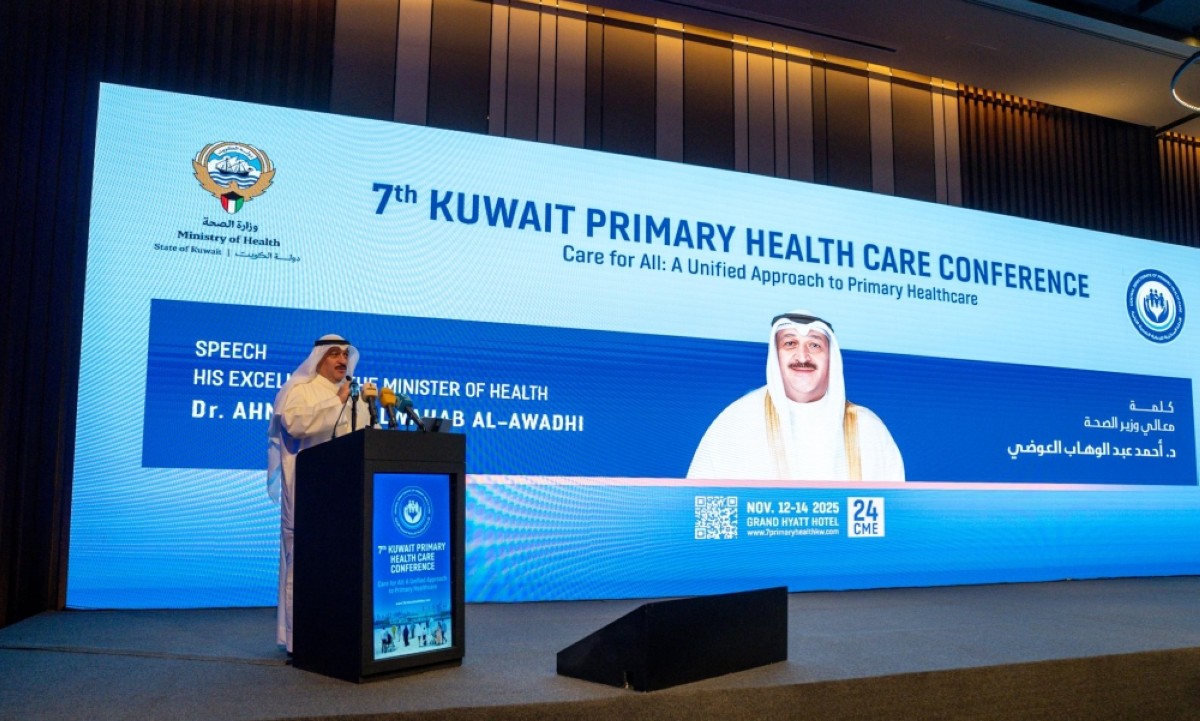
Healthcare infrastructure ‘a cornerstone of health renaissance, sustainable development’
KUWAIT: Minister of Health Dr Ahmad Al-Awadhi affirmed that developing Kuwait’s healthcare infrastructure is a cornerstone of the national health renaissance and sustainable development. His remarks came during the opening address of the 7th Kuwait Primary Healthcare Conference, held Wednesday under the theme “Care for All: A Unified Approach to Primary Healthcare.” The three-day event is being attended by specialists and experts from Kuwait and abroad.
Dr Al-Awadhi highlighted the Ministry’s ongoing efforts to expand the network of primary healthcare centers, which form the backbone of the country’s health system. The number of centers has now reached 118, with plans to continue developing modern facilities, particularly in new residential areas in Jahra, Ahmadi and Farwaniya governorates, to accommodate population growth and ensure the provision of high-quality healthcare services.
The minister noted that three health centers are currently undergoing comprehensive renovation and construction, while three new centers are set to open soon: Jaber Al-Ahmad Health Center (Block 4), West Abdullah Al-Mubarak Health Center (Block 6), and Kabd Health Center. Several additional centers are also under construction and being equipped with modern medical facilities.
Dr Al-Awadhi stressed that rapid and effective emergency response remains a top priority. Many primary healthcare centers have been equipped with modern emergency departments operating according to international medical standards. Notably, Sabah Al-Ahmad Center and Al-Mutlaa N10 Center now feature CT scanners, enhancing coverage and access for residents. He added that primary healthcare centers employ 1,887 physicians across various specialties, supported by over 7,000 nursing, technical, pharmaceutical, and laboratory staff, forming an integrated system for delivering comprehensive health services.
The centers have recorded more than 16 million visits this year, reflecting the public’s confidence in Kuwait’s healthcare system. The minister praised the dedication of medical, technical, and administrative staff in achieving these results. Dr Dina Al-Dhaib, Director of the Central Department of Primary Healthcare and Head of the Conference, emphasized the Ministry’s commitment to developing a scientific program that aligns with modern medical advancements and strengthens professional collaboration among healthcare practitioners through expert-led workshops and specialized sessions.
Dr Al-Dhaib noted significant expansion in primary healthcare services and specialized clinics in recent years. Chronic disease clinics have increased to 133, mental health clinics to 74, diabetes clinics to 215, and retinal examination clinics to 68, equipped with artificial intelligence technologies. Additional services include 95 diabetic foot clinics, 100 well-child and adolescent clinics, and 64 clinics for the elderly. This expansion is supported by continuous investment in training and qualifying medical personnel.
The number of physicians in primary care centers has reached 1,887, including 472 graduates of the Kuwaiti Board of Family Medicine. The Ministry plans to increase this number to approximately 900 by 2030. Kuwait is the first country in the Middle East to receive recognition from the Royal College of General Practitioners (RCGP) for the Kuwaiti Board of Family Medicine, with 60 health centers accredited as approved training centers to date. The conference underscores Kuwait’s commitment to building a modern, accessible, and comprehensive primary healthcare system that meets the evolving needs of its population. — KUNA
