

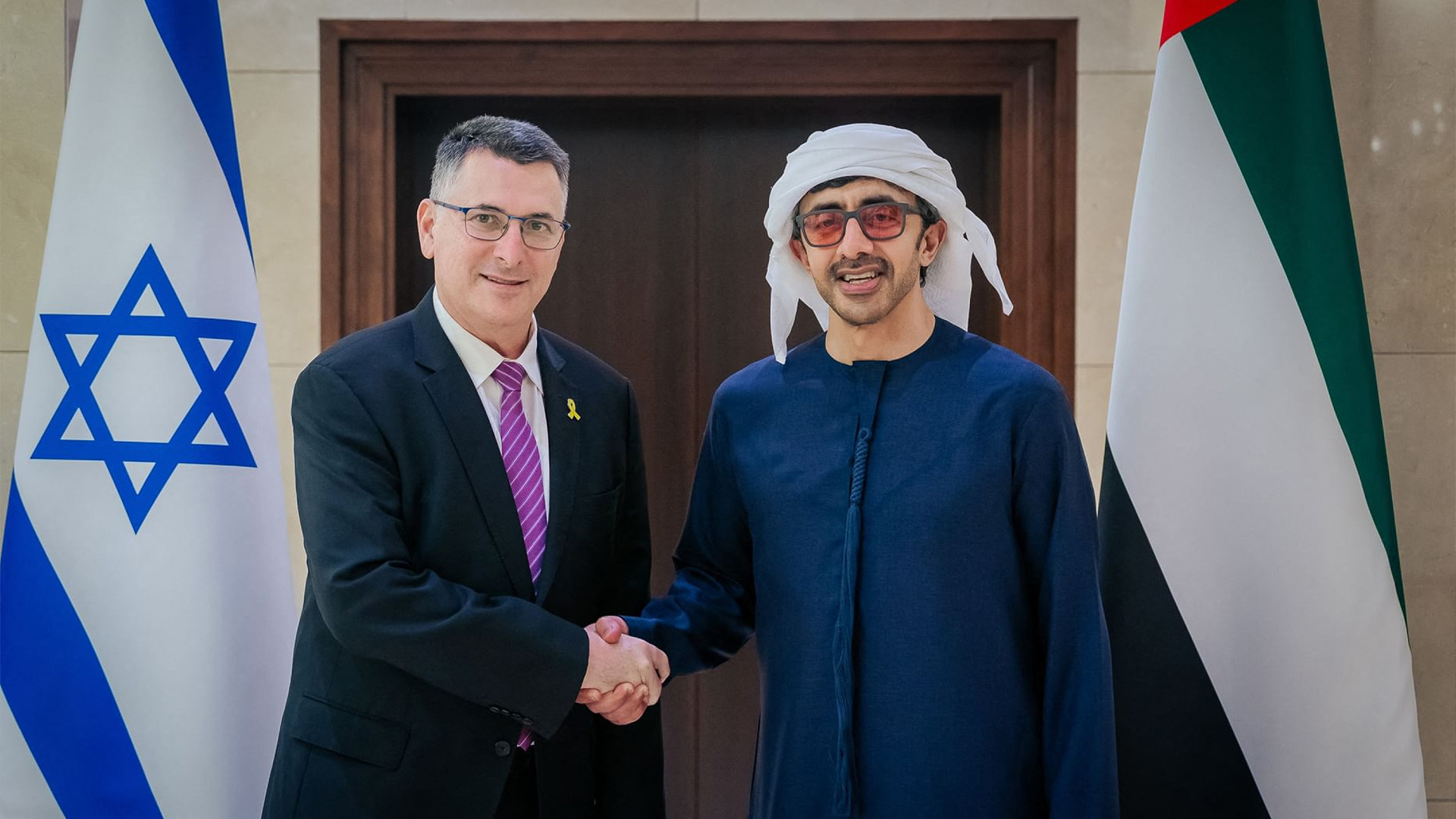
One of the key US policies in the Arab world is to bring about “normalisation” of relations between all Arab countries and Israel in order to encircle the Palestinians with allies of their colonisers and deprive them of any external support.
Previously, the 1993 Oslo I Accord transformed the Palestine Liberation Organization (PLO) from a liberation movement into a subcontractor of Israel’s occupation to encircle the Palestinians within the occupied territories themselves.
This containment strategy was meant to quash the Palestinian struggle once and for all. When Palestinian resistance persisted, culminating in the October 2023 Al-Aqsa Flood operation, the strategy was not reconsidered but rather further accelerated.
Since the 2020 announcement of the Abraham Accords, normalisation efforts have expanded beyond Arab states to include Muslim-majority countries that were never at war with Israel, yet did not have diplomatic relations with it.
Most recently, in November, the Trump administration touted Kazakhstan’s formal accession to the Accords, even though it already maintained “full diplomatic relations” with Israel.
Indonesia, which does not have diplomatic relations with Israel, is also reportedly weighing normalisation.
This expansion comes as several Arab initiatives have stalled in the wake of Israel’s genocide in Gaza, most notably with Saudi Arabia, and even Libya, whose foreign minister met with her Israeli counterpart in Italy in August 2023, before the ongoing mass slaughter of Palestinians rendered the process untenable.
Long before the US advanced normalisation with Israel as a regional strategy, it had already been articulated as a Zionist one.
New MEE newsletter: Jerusalem Dispatch
Sign up to get the latest insights and analysis on
Israel-Palestine, alongside Turkey Unpacked and other MEE newsletters
Since the early 1920s, the Zionist Organization operated on the premise that “if it is impossible to get an endorsement of Zionism by Palestine’s Arabs, then it must be obtained from the Arabs of Syria, Iraq, Saudi Arabia and perhaps of Egypt”.
Today, it appears the Israelis have been steadily securing such endorsement not only from Palestinian leaders, but also from leaders across the Arab and Muslim worlds.
Zionist precedents
In the 1920s, the Revisionist Zionist leader Vladimir Jabotinsky mistakenly viewed the Zionist pursuit of Arab recognition as misguided.
He argued that, to extinguish the Arab countries’ hopes in defeating Zionism, “we would have to offer them something just as valuable. We can offer only two things: either money or political assistance or both”.
Jabotinsky clearly laboured under the delusion that the Arab countries were governed by anti-colonialists rather than by rulers already collaborating with western imperialism
Jabotinsky concluded that the Zionists lacked sufficient funds and that those states required anti-colonial assistance that Zionism could not provide, since “we cannot intrigue about removing Britain from the Suez Canal and the Persian Gulf and the elimination of French and Italian colonial rule over Arab territory. Such a double game cannot be considered on any account”.
Jabotinsky clearly laboured under the delusion that the Arab countries were governed by anti-colonialists rather than by rulers already collaborating with western imperialism, even then, let alone now.
What he failed to realise was that the Zionists could indeed offer the Arab countries political assistance, not to oppose colonial influence, but to maintain and intensify imperialism’s role in safeguarding the thrones of monarchical regimes.
In addition to those Arab countries that normalised relations with Israel from the late 1970s through the 2020 Abraham Accords, Libya was not the only new addition, as Iraq and Tunisia have also held secret talks with Israel aimed at normalisation.
Normalisation outcomes
Unlike Jabotinsky, the Israelis and US President Donald Trump understand the inevitability of normalisation with Arab countries, including Saudi Arabia, whose warm relations with Israel have yet to translate into formal diplomatic ties.
Pro-normalisation forces in the Arab world argue that diplomatic and cordial relations with Israel would enable Arab normalisers to exert pressure on it to grant Palestinians some of their rights and end the occupation of the territories seized in 1967.
They further claim that such relations would usher in regional stability and prosperity.
That the record of the past 50 years of normalisation has instead produced catastrophes, wars, expanded colonisation, resistance and genocide seems not to have dulled these fantasies. A short review of what normalisation has led to can perhaps complicate this picture.

Israel’s violent expansion is never done, yet it still cannot ‘finish the job’
Read More »
One of the first cases involved the Palestinians themselves. Between 1973 and 1977, the PLO, specifically Fateh and the Democratic Front for the Liberation of Palestine, began meeting in Europe with members of the Israeli Communist Party and other leftist Zionist Israelis in an effort to establish a “dialogue”.
During this period, the PLO proffered various clandestine plans to negotiate with the Israeli government, including establishing a state in the West Bank and Gaza and relinquishing any claims to “Israeli” territory.
Such proposals were sent directly to then-Israeli Prime Minister Yitzhak Rabin, who rejected them outright and prohibited Israelis from meeting with the Palestinians.
As for the economic viability of the PLO-proposed mini-state, its chairman, Yasser Arafat, argued as early as 1975 that “Amilcar Cabral is building an independent state in Guinea-Bissau, one of the smallest and poorest states on the planet. It is the same with the South Yemenis who have established their republic despite the wretched circumstances in their country”.
The shift towards seeking an “independent state”, rather than total liberation, marked a fundamental change in the nature of the Palestinian struggle.
However, after making these concessions to the West in the hope of being deemed sufficiently “moderate” to participate in future negotiations and the then prospective Geneva Conference, the PLO was blindsided by Egyptian President Anwar Sadat.
With American backing, Sadat opted for a solo act, travelling directly to Israel in November 1977, following Menachem Begin’s election as its prime minister and Likud’s rise to power, having already conducted secret negotiations with Israeli leaders.
Separate settlements
Not only did Sadat fly to Israel, but he also agreed to address its parliament, the Knesset, in Israeli-occupied Jerusalem rather than in Tel Aviv, where all countries then located their embassies in refusal to recognise Israel’s illegal annexation of either West or East Jerusalem.
As no other Arab leader, let alone the Palestinians, had been consulted or informed of the impending trip, Sadat’s initiative pulled the rug from under the Soviets, co-chairs of the prospective Geneva peace conference, and from the Arab countries, all of which, along with the PLO, condemned his visit as opening the way to a separate settlement with Israel.
Follow Middle East Eye’s live coverage of Israel’s genocide in Gaza
The insistence on separate settlements, a strategy long employed by Israel, was designed to pit the interests of one Arab country against another, and against the Palestinians, rather than pursue a comprehensive regional resolution to the ongoing colonisation of Arab land.
Sadat moved swiftly to expel PLO representatives from Cairo, and in April 1979, the Arab League expelled Egypt as a member and relocated its headquarters from Cairo to Tunis. The majority of the Arab countries subsequently severed diplomatic relations with Egypt.
Once Sadat had removed Egypt from the military equation with Israel, the strategic balance shifted rapidly.
Even before the Camp David framework was concluded in September 1978 – later ratified with the signing of the peace treaty in Washington in March 1979 – the Israelis launched a major invasion of Lebanon in March, targeting PLO guerrillas whose attacks on the Israeli settler-colony continued.
Israel invaded, knowing well that the Egyptian army no longer posed a threat.
The invasion killed more than 4,000 Palestinian and Lebanese civilians and drove a quarter of a million refugees from southern Lebanon northward. It also led to the deployment of the United Nations Interim Force in Lebanon (Unifil) along the border.
Israel relied on local collaborators in Lebanon, including Major Sa’d Haddad, a renegade Lebanese Christian general who founded the South Lebanon Army, which allied itself with Israel against the PLO and leftist Lebanese forces.
Although Israeli forces partially withdrew, they continued to occupy a strip of Lebanese territory they designated as a “security zone”. Israel persisted in attacking PLO forces over the next four years, before launching a second massive invasion of the country in 1982 that effectively destroyed the PLO’s military capability.
Arab concessions
The Camp David negotiations between Egypt and Israel also addressed the future of the West Bank and Gaza, which both parties asserted required a separate treaty.
As for Sinai, the March 1979 treaty provided for the complete withdrawal of Israeli forces over a three-year period and the dismantlement of Jewish colonies there.
Sinai was to remain demilitarised, with only Egyptian police, and not the Egyptian army, permitted to be stationed in the peninsula. The treaty also provided for the exchange of embassies between the two states.

‘Normalisation’ with Israel: What it means and why it’s not happening
Read More »
Regarding the West Bank and Gaza, the Camp David framework envisioned a transitional period of five years during which a self-governing authority would be elected by the Palestinian inhabitants, granting them mere autonomy, with only a partial withdrawal and redeployment of Israeli forces within the occupied territories.
The autonomy scheme Israel offered amounted to no more than what the head of the Zionist Organization, Chaim Weizmann, volunteered in 1930 as the maximum concession Zionist colonists could ever make to the Palestinians.
Clearly, the Zionist position had remained unchanged over the previous four decades.
The Egyptians nonetheless continued to negotiate with the Israelis and Americans to conclude a comprehensive Middle East peace, with a target date of 26 May 1980. These negotiations, however, were neither resumed nor concluded, and the matter was quietly abandoned.
The Israeli proposal made no mention of a Palestinian state, the rights of refugees or the status of Jerusalem. Self-determination was reduced to autonomy, and Begin stated openly his intention to annex the territories once the transitional period expired.
Not only was the question of settlements not resolved, but in 1979, Begin had embarked on a re-energised settlement programme to alter the demographics of the Palestinian territories and establish a Jewish settler majority.
Renewed attacks
In the wake of Camp David normalisation with Egypt, Israel moved to formally annex East Jerusalem in July 1980, a move immediately condemned by UN Security Council Resolution 478, which declared the annexation “null and void”. This was followed by Israel’s annexation of the Syrian Golan Heights in December 1981, also condemned by UN Security Council Resolution 497 as “null and void”.
In July 1981, the UN brokered a ceasefire between the PLO and Israel. The PLO did not violate it once during the ensuing 11 months, even as Israel breached it repeatedly.
The peace plans emboldened Israel to launch a second invasion of Lebanon in June 1982, killing some 20,000 Palestinian and Lebanese civilians and creating another half a million refugees
In April 1982, Israeli forces bombed Lebanon, killing 25 people and injuring 80, without provoking retaliation. A few weeks later, a second Israeli bombing raid killed another 11, prompting a limited PLO response that inflicted no casualties.
Meanwhile, in June 1981, Israel launched a raid destroying Iraq’s nuclear reactor, which did not possess nuclear weapons capabilities.
Israel’s pattern of welcoming Palestinian and Egyptian concessions while refusing to concede any rights to the Palestinians continued. In 1981, Saudi Crown Prince Fahd announced a peace plan offering Arab recognition of the Jewish settler-colony in exchange for an end to Israel’s occupation of the territories it seized in 1967 and the establishment of a Palestinian state.
It was hoped that this would end Israel’s status as the primary enemy of the Arabs and replace it with Iran, which had just staged an anti-American revolution and deposed the tyrannical Shah.
The Americans cautiously praised the plan, Arafat welcomed it, while the Israelis rejected its terms yet embraced the prospect of regional recognition.
Together, the Camp David Accords and the Fahd Peace Plan emboldened Israel to launch a second invasion of Lebanon in June 1982, killing some 20,000 Palestinian and Lebanese civilians and creating another half a million refugees.
This Israeli response to concessions and promises of normalisation has persisted. Today, the Lebanese government’s submission to Israeli and US demands for prospective normalisation has likewise been met with renewed Israeli attacks on Lebanon and further occupation of its territory.
Granting impunity
Following the normalisation between Israel and the PLO in 1993, and between Jordan and Israel in 1994, the Palestinians became an Israeli-subcontracted repressive force against their own people, while Jordan was cultivating increasingly warm relations with Israel even as it continued to intensify its occupation.
This situation eventually led to the Second Palestinian uprising between 2000 and 2005, which effectively brought the so-called “peace process” to an end.
Still, it left intact the Palestinian Authority as a servant of the Israeli occupation and expanded Israel’s economic and diplomatic relations with Jordan.
Israel responded to the 2020 Abraham Accords of normalisation with four Arab countries in the same manner. The Accords signalled that Israel could act towards the Palestinians with impunity, including its carrying out of the current genocide, which none of the signatories opposed.
Indeed, the Arab signatories, along with other Arab normalisers, reportedly helped the Israelis and deepened their relations with them as the genocide proceeded.

Israel’s attack on Qatar should be a wake-up call for the Arab world
Read More »
Contrary to American and pro-American Arab propaganda that normalisation would help stabilise the region, quash Palestinian resistance and restore Palestinian rights, the record of PLO and Arab “normalisation” with Israel has instead produced major Israeli invasions, intensified settler-colonisation, sustained Palestinian resistance and, most recently, the perpetration of genocide.
As a reward for the Arab normalisers, Netanyahu has even spoken openly of a “Greater Israel” encompassing the territories of some normalising Arab states.
Normalisation has also not spared countries from Israeli hostility, including Egypt and Jordan, which have been constantly threatened by Israeli leaders, and even the Qatari conciliators who were bombed for their efforts at the behest of the US and Israel.
What is astonishing is that, despite this dismal historical record, pro-normalisation Arabs continue to entertain hopes that Donald Trump’s efforts to expand normalisation with Israel will bring about regional stability and peace.
That Israel has bombed Qatar, is now bombing Syria and Lebanon, whose leaders openly court normalisation, and continues to occupy more land, has hardly made a dent in this pro-normalisation propaganda.
The idea that collaboration and normalisation would extinguish Palestinian resistance has proven no less illusory.
The views expressed in this article belong to the author and do not necessarily reflect the editorial policy of Middle East Eye.
