

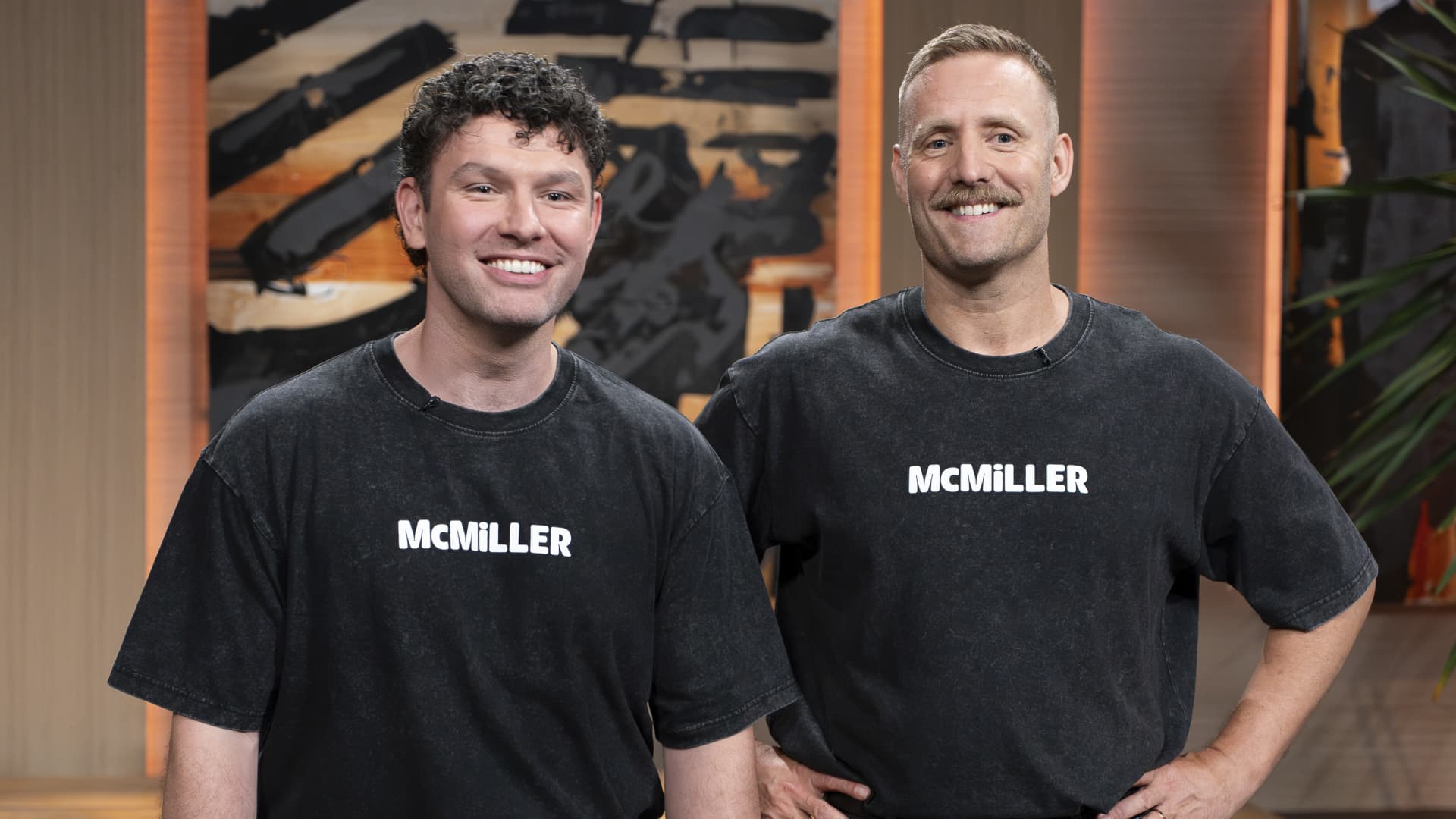
A side hustle born from Covid-era boredom has generated more than $12.5 million in revenue for entrepreneurs David McGranaghan and Julian Miller, the duo said on Wednesday’s episode of ABC’s “Shark Tank.”
McGranaghan and Miller, a married couple based in Los Angeles, are the founders of party and board game business McMiller. They’re both former professional stage and film actors who, in 2020, decided to turn some of the party games they’d invented to liven up family holiday gatherings into a business, they said.
“The entertainment was always on our shoulders” at family Christmas parties, said Miller. The positive response from their respective families convinced them that “we must be onto something,” he noted.
The first game they launched in 2020, and their most popular one to date, is called It’s Bananas. Players pick up cardboard cutouts using long, curved plastic “monkey tails” that participants wear with a velcro strap around their waists. The game’s target audience is “multi-generational,” said McGranaghan, adding that it’s most popular at family holiday gatherings and bachelor and bachelorette parties.
DON’T MISS: The ultimate guide to starting a business—everything you need to know to be your own boss
Selling mostly on Amazon and their own website, It’s Bananas generated “nearly $1 million” in sales within a year, Miller said. The quick success turned their “part-time hustle” into their full-time focus, the couple added. They’ve launched four more games over the past five years, including their most recent, called Fish Fight, which debuted in February.
Notably, McGranaghan had some prior industry experience: He co-created a board game called Game for Fame in 2008, which became a top seller on Amazon, according to the Daily Mail.
At the time the “Shark Tank” episode taped, McMiller had sold more than 650,000 units since launching, totaling more than $12.5 million in sales — the bulk of which came from It’s Bananas, the co-founders said. It was on track to top $5 million in sales for 2025, with profits of $750,000, they added.
Their games typically sell for $23.99 per unit, and a “landed cost” of just $3 per unit for McMiller gives the business a “great margin,” investor and entrepreneur Lori Greiner said on the show.
From initial skepticism to a bidding war
McGranaghan and Miller kicked off their “Shark Tank” presentation by asking the show’s investor judges for a $200,000 investment in exchange for a 5% stake of McMiller, which would have valued the business at $4 million.
FUBU founder and CEO Daymond John bristled at the large valuation. “I hate that valuation. You’re never going to get a deal. You’re going to waste my time. Go ahead,” he said. After hearing about McMiller’s revenue figures, John changed his tune, exclaiming: “Holy crap!”
Fellow investor Kevin O’Leary still pushed back on the proposed valuation, noting that much of McMiller’s sales came from one hit game and repeating that success with subsequent products could be difficult.
“The risk on the deal is you decide to go into retail with these new SKUs that are unproven. They [might] sit on the shelf in retail, they tie up your capital. This is the challenge of the toy industry,” O’Leary said.
Miller and McGranaghan expressed confidence that their flagship game will maintain its popularity while they wait for new games to catch on with customers. Plus, an investment from a Shark could help fund expansion into brick-and-mortar retail stores in the U.S. and overseas to boost future revenue, they suggested.
Real estate mogul Barbara Corcoran offered McMiller $200,000 for a 10% stake in the business, valuing it at $2 million. John matched that offer, with both potential deals including the stipulation that the investors would receive $2 back for every unit sold until they recouped the investment.
Billionaire Kind Snacks founder Daniel Lubetzky also matched the offer, promising to connect the founders with his toy industry connections — noting that he was “very, very good friends” with the CEOs of Hasbro and Mattel. After some negotiating, the founders agreed to a deal: Lubetzky would invest $200,000 for 9% of the company, valuing it at $2.2 million, and receive $0.99 per unit until he recouped his investment.
Following their on-screen agreement, Miller called it “a match made in heaven.” After the episode’s taping, the founders “decided not to move forward” with the deal because “soon after filming [the episode], McMiller experienced significant momentum and major store orders, which shifted our strategic direction,” a McMiller spokesperson tells CNBC Make It.
The founders are “incredibly grateful for the platform the show provides” and Lubetzky’s interest, the spokesperson says.
Disclosure: CNBC owns the exclusive off-network cable rights to “Shark Tank.”
Want to be your own boss? Sign up for CNBC’s new online course, How To Start A Business: For First-Time Founders. Find step-by-step guidance for launching your first business, from testing your idea to growing your revenue.

