

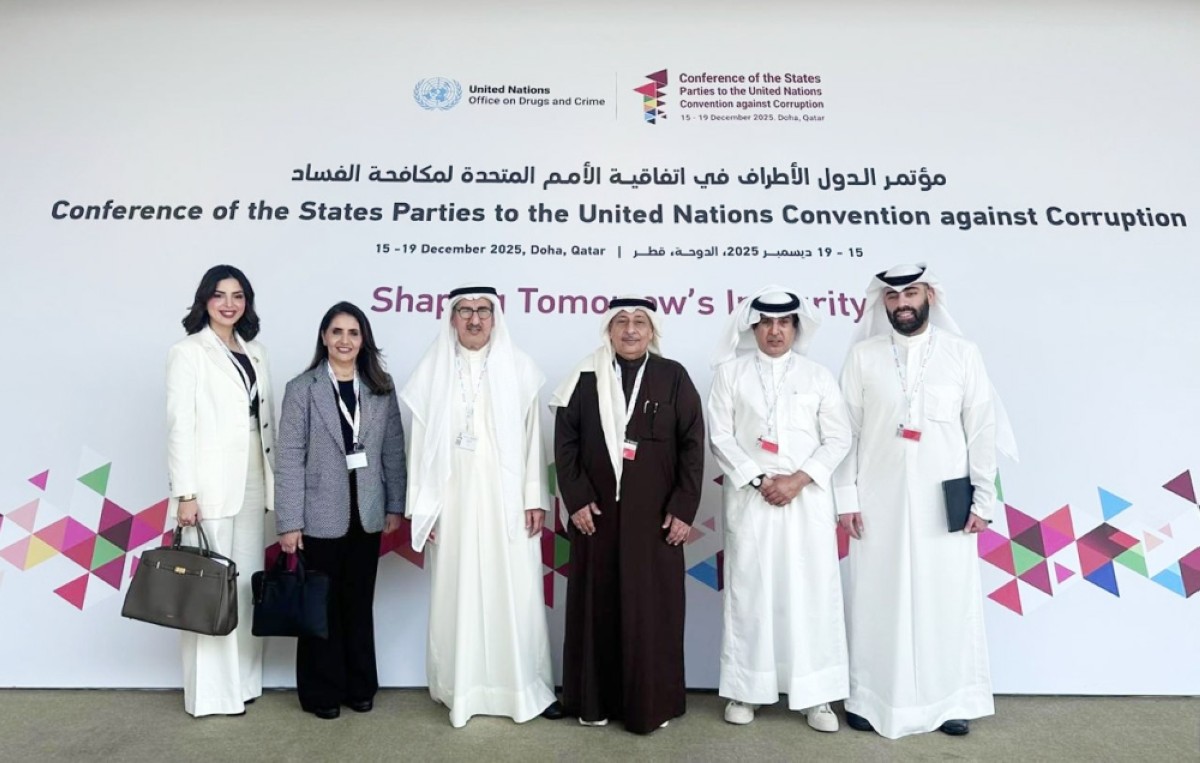
KUWAIT: The Kuwait Anti-Corruption Authority (Nazaha) took part in organizing and presenting three specialized workshops during its participation in the 11th Conference of the States Parties to the United Nations Convention against Corruption, hosted by the Qatari capital, Doha. In a statement issued on Thursday, Nazaha said its contribution comes as part of its ongoing efforts to strengthen international cooperation and exchange expertise in combating corruption. It noted that the workshops attracted wide interest from participating delegations at the conference, which began on Monday and concludes on Friday.
During a session titled “Promoting Integrity and Accountability in Public Institutions,” Nazaha reviewed the “Adaa” (Performance) project, launched in cooperation with the Civil Service Bureau and implemented across various government entities. The project aims to enhance the work environment and professional ethics, improve public sector performance, and institutionalize ethical principles through a unified and consistent approach. Nazaha highlighted the project’s role in activating codes of conduct and public service ethics as a mandatory framework to reinforce integrity and transparency and ensure the delivery of high-quality, fair and equitable government services.
In another session entitled “From Hidden Owners to Shared Data: Leading Impact in Beneficial Ownership,” Nazaha presented its “Beneficial Ownership Guide,” developed within the framework of the GlobE Network and the GCC Ministerial Committee for Combating Corruption. The guide focuses on mechanisms for disclosing beneficial ownership in companies and legal entities, describing it as an effective tool in combating money laundering and terrorist financing and in enhancing financial transparency in line with international standards.


In a third session, “Transforming National Anti-Corruption Strategies into Practical Application,” Nazaha provided a comprehensive overview of the outcomes of its current strategy and progress in preparing and updating the National Strategy for Promoting Integrity and Combating Corruption beyond 2025. The Authority stressed the importance of future-oriented planning based on scientific principles to address evolving corruption challenges. Nazaha said its active participation reflects Kuwait’s firm commitment to implementing the United Nations Convention against Corruption, the only legally binding international instrument in this field. The workshops, it added, helped highlight national efforts, facilitate the exchange of best practices, and build joint capacities to confront transnational corruption.
The Authority is participating in the conference with a high-level delegation headed by Nazaha Chairman Abdulaziz Al-Ibrahim, and including Assistant Secretary-General for Prevention Engineer Abrar Al-Hammad, Director of the Chairman’s Office Khalid Al-Rumaihi, and International Organizations and Conferences Observer at the International Cooperation Department Dhari Buayabs. The Conference of the States Parties is held biennially in accordance with Article 63 of the UN Convention against Corruption, with the aim of enhancing cooperation and capacity-building among member states and promoting effective implementation of the convention.
Qatar, represented by the Administrative Control and Transparency Authority, is hosting the 11th session, which features high-level participation by heads of state, ministers and leaders of law enforcement and anti-corruption bodies. Meanwhile, Assistant Secretary-General for Prevention at Nazaha, Engineer Abrar Al-Hammad, underscored the importance of Kuwait’s participation in the conference. In a statement to the Kuwait News Agency (KUNA), she said the delegation, led by Al-Ibrahim, delivered key interventions during the sessions.
Al-Hammad noted that the Nazaha chairman addressed the opening day of the conference, stressing the need to develop mechanisms for assessing corruption risks, measuring public perceptions of corruption, analyzing trends, and identifying links between corruption and other criminal activities. She added that during her participation in the session on promoting integrity and accountability, she emphasized that work ethics are no longer optional ideals but essential requirements for ensuring integrity and justice in public institutions.
She outlined Kuwait’s experience, explaining that Nazaha conducted studies of the Public Employees’ Code of Conduct and held interactive workshops with staff from 70 entities to identify gaps and challenges, including overly legalistic language and the absence of deterrent penalties. To address these issues, she said, Nazaha launched the “Adaa” project to support the effective implementation of the Code of Conduct. She also highlighted Kuwait’s experience with the National Strategy for Promoting Integrity and Combating Corruption, noting that it recently earned the Arab Government Excellence Award for Best Arab Initiative for Developing Government Work.
Al-Hammad said Nazaha also took part as a speaker in sessions organized by the GlobE Network on beneficial ownership, sharing Kuwait’s experience in developing a guide for GCC countries to identify beneficial owners as a tool to combat money laundering and terrorist financing. She expressed her appreciation to Qatar for hosting the conference and praised the organization and hospitality, noting that Kuwait was among the first countries to ratify the UN Convention against Corruption in 2003 and remains committed to its objectives. — KUNA
