

The first time the man who is now my husband told me he loved me, I was on my way to al-Arroub Refugee Camp in the occupied West Bank to tend to people Israeli forces had just attacked.
He had sent me a voice note, and amid the chaos inside the ambulance, I kept replaying it, trying to hear whether he had really said “I love you” at the end.
The siren was blaring as my colleagues urgently debated which roads were still open and whether we could reach the camp. I was so focused on that small, tender moment that I did not register the danger until it hit my nostrils. The burning was instant, searing my throat and eyes. We had been tear-gassed.
We opened the ambulance doors expecting panic, but instead found women standing calmly, eyes streaming from the fumes. No screams. No chaos. Just quiet resignation. This was not new to them. This was routine.
That moment taught me something I have not since forgotten: in Palestine, even the smallest, most intimate moments can never simply exist on their own.
New MEE newsletter: Jerusalem Dispatch
Sign up to get the latest insights and analysis on
Israel-Palestine, alongside Turkey Unpacked and other MEE newsletters
They take place within the occupier’s violence, a constant presence.
I realised how easily the abnormal becomes normalised; how even I, inside an ambulance heading towards an attack, had briefly zoned out into the softness of ordinary life.
It was not until the gas hit my lungs that I understood again what Palestinian women know too well: the everyday is never only everyday under occupation.
Obstructed care
I have been visiting the West Bank regularly since 2003.
One early incident during the Second Intifada has stayed with me: an ambulance was denied entry.
At the time, all major roads were closed. A group of us – women, children and elderly people – were stranded outside Bethlehem, waiting for any transport that might take us towards Hebron.
From where we stood, we watched an ambulance attempt to pass a checkpoint with a woman in urgent need of care. Soldiers refused. The ambulance pulled over to ask us whether any roads were still open, then drove on, hoping to reach a hospital elsewhere. Moments later, a military jeep swerved towards us, and soldiers ordered everyone present to disperse on foot into unmarked terrain.
That was the moment I understood how deeply healthcare in Palestine is subject to military power, and how quickly ordinary life can become perilous.
I understood how deeply healthcare in Palestine is subject to military power, and how quickly ordinary life can become perilous
Since 2018, through my work with the Palestinian Medical Relief Society’s mobile clinics, I have travelled to villages where reproductive care depends not on medical need but on checkpoints and unpredictable military closures.
I have been harassed at checkpoints simply for trying to deliver healthcare. I have seen female colleagues subjected to aggressive, degrading body searches.
In communities such as Khan al-Ahmar, I have witnessed women assaulted during demolitions, their hijabs ripped from their heads. I have watched young Palestinian women abandon their studies or work because daily travel through military zones became too dangerous.
And then there is the violence inflicted not on women’s bodies, but on their children.
In my first weeks living in Bethlehem in 2018, the Dheisheh Refugee Camp was raided. A 13-year-old boy was shot dead in his bed.
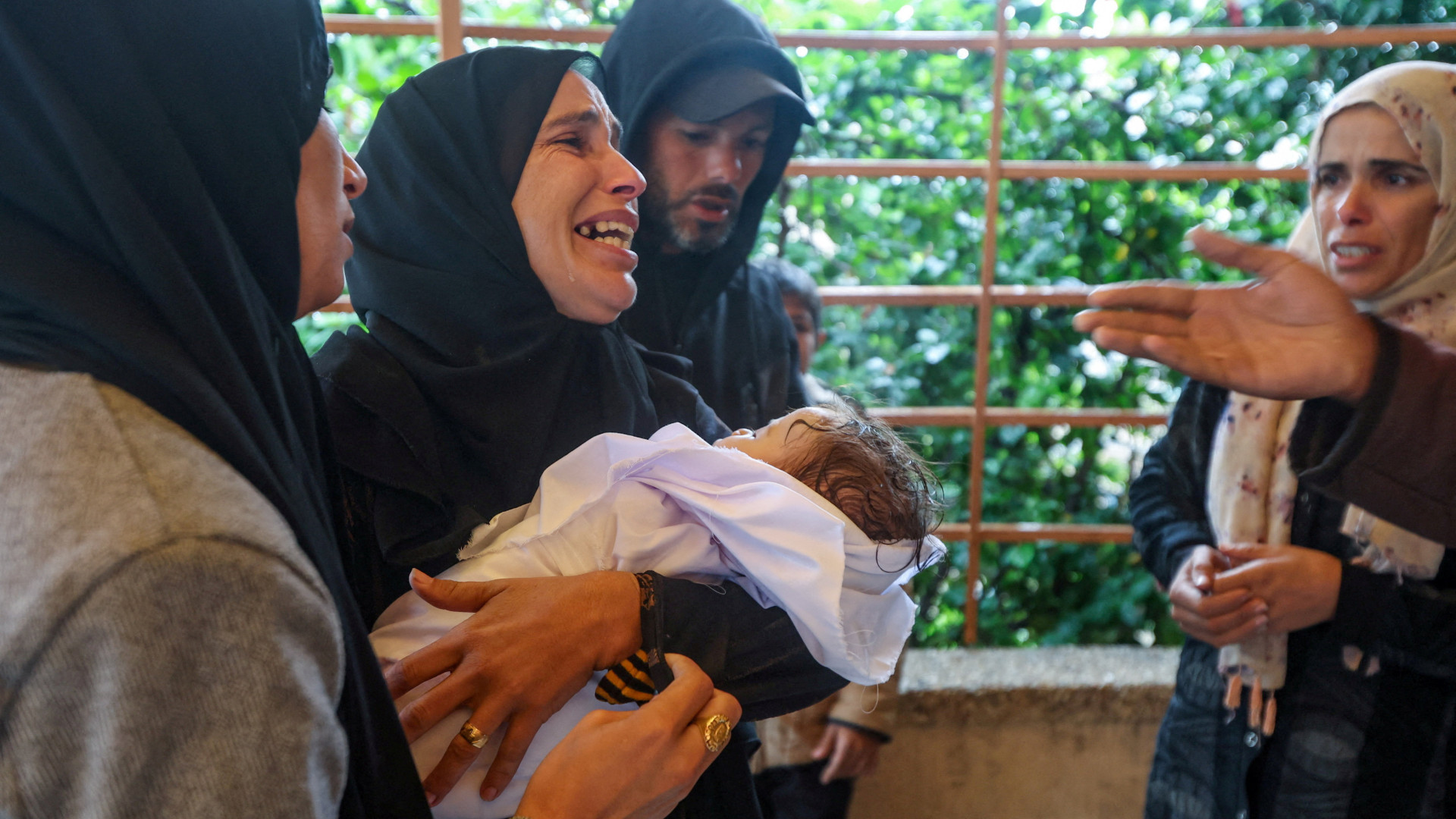
The next morning, I watched his mother lead the funeral procession through the town – her grief palpable, her strength unimaginable. The way she walked, and the image of her carrying her son’s tiny body surrounded by neighbours, is seared into my memory. The bullet did not pierce her body, but it shattered her life.
Violence against children
In Gaza, this violence has reached an unimaginable scale. Dr Alaa al-Najjar, a physician, saw nine of her 10 children killed in a targeted attack on her home. She survived. They did not.

What it’s like to survive in Gaza when your children are killed
Read More »
It is not only through bombings that Palestinian mothers endure violence. The assault on their children takes many forms, at any moment – during school runs, in prisons, at checkpoints, during night raids, while their babies should be asleep in their beds.
UN estimates and Israeli military data indicate that between 38,000 and 55,000 Palestinian children have been detained under military law since 1967.
Before October 2023, around 170 children were in detention. Since then, more than 1,300 have been arbitrarily arrested, and at least 440 remain illegally imprisoned today. Their absence devastates families in ways statistics can never capture.
While my focus is on women, gender-based violence and reproductive genocide harm men, boys and people of all gender identities. But for mothers, the violence inflicted on their children is a uniquely shattering form of gendered harm, one rarely acknowledged in international law or humanitarian policy.
Such violence does not wound mothers only through their bodies, but through their hearts and identities. It reflects a settler-colonial biopolitics that reduces Palestinian women to reproductive vessels while disregarding the emotional, relational and communal worlds that define their humanity.
Follow Middle East Eye’s live coverage of Israel’s genocide in Gaza
This is the landscape in which Palestinian women make decisions about their bodies and their futures.
Between 2000 and 2004, nearly 100 Palestinian women were forced to give birth at Israeli checkpoints. At least 54 newborns died because soldiers delayed or denied passage. These were early signs of how even childbirth was being shaped by military control long before the current genocide.
Reproductive genocide
What is happening in Gaza now is far more extreme.
A recent UN Commission of Inquiry report documents the systematic destruction of reproductive health services, the obstruction of maternal and neonatal care, and the use of sexual violence. These findings align with Article II(d) of the Genocide Convention: “imposing measures intended to prevent births within the group”.
“Reproductive genocide” is not a standalone legal category, but it accurately describes this specific genocidal act: the deliberate destruction of a population’s reproductive capacity.
Gaza’s main IVF centre has been obliterated, along with thousands of embryos. Maternity wards lie in ruins. Premature babies are dying due to a lack of electricity. Caesareans are being performed without anaesthesia. More than 155,000 pregnant and breastfeeding women face near-total denial of care.
Malnutrition, dehydration, contaminated water and constant displacement are causing miscarriages and stillbirths. These are not incidental losses. They are the predictable outcomes of deliberate policies.
Yet during the 16 Days of Activism – a global campaign on gender-based violence – Palestinian women remained largely absent from the conversation. This was no accident. Violence against Palestinian women is routinely depoliticised, treated as though it exists apart from military occupation and siege.
But gender-based violence in Palestine is inseparable from political violence: from checkpoints that block access to hospitals, to bombs that destroy maternity wards, to siege policies that starve pregnant bodies.
Reproductive health is not a side issue. It is a frontline human rights issue, and its destruction is a frontline indicator of atrocity.
Reproductive health is not a side issue. It is a frontline human rights issue, and its destruction is a frontline indicator of atrocity
In PMRS mobile clinics, I have worked with midwives who carry entire communities on their backs. Their courage is extraordinary. But resilience must not be romanticised. It must never be demanded as a substitute for rights.
If the world is serious about ending gender-based violence, it must name what is happening in Gaza: a systematic assault on reproductive life. It must amplify the voices of Palestinian women and hold accountable those responsible for destroying reproductive health infrastructure. And it must insist that the right to give birth safely, and to raise a child in dignity, is fundamental.
The fate of a people is bound to the fate of its women.
What happened in that ambulance – the instant shift from tenderness to gas, from intimacy to survival – is not exceptional in Palestine. It is the theft of the ordinary. And the ordinary is a right.
Until Palestinian women can live a day that is simply a day, free from occupation, colonisation and violence that fractures every moment, there can be no meaningful justice.
The views expressed in this article belong to the author and do not necessarily reflect the editorial position of Middle East Eye.
