

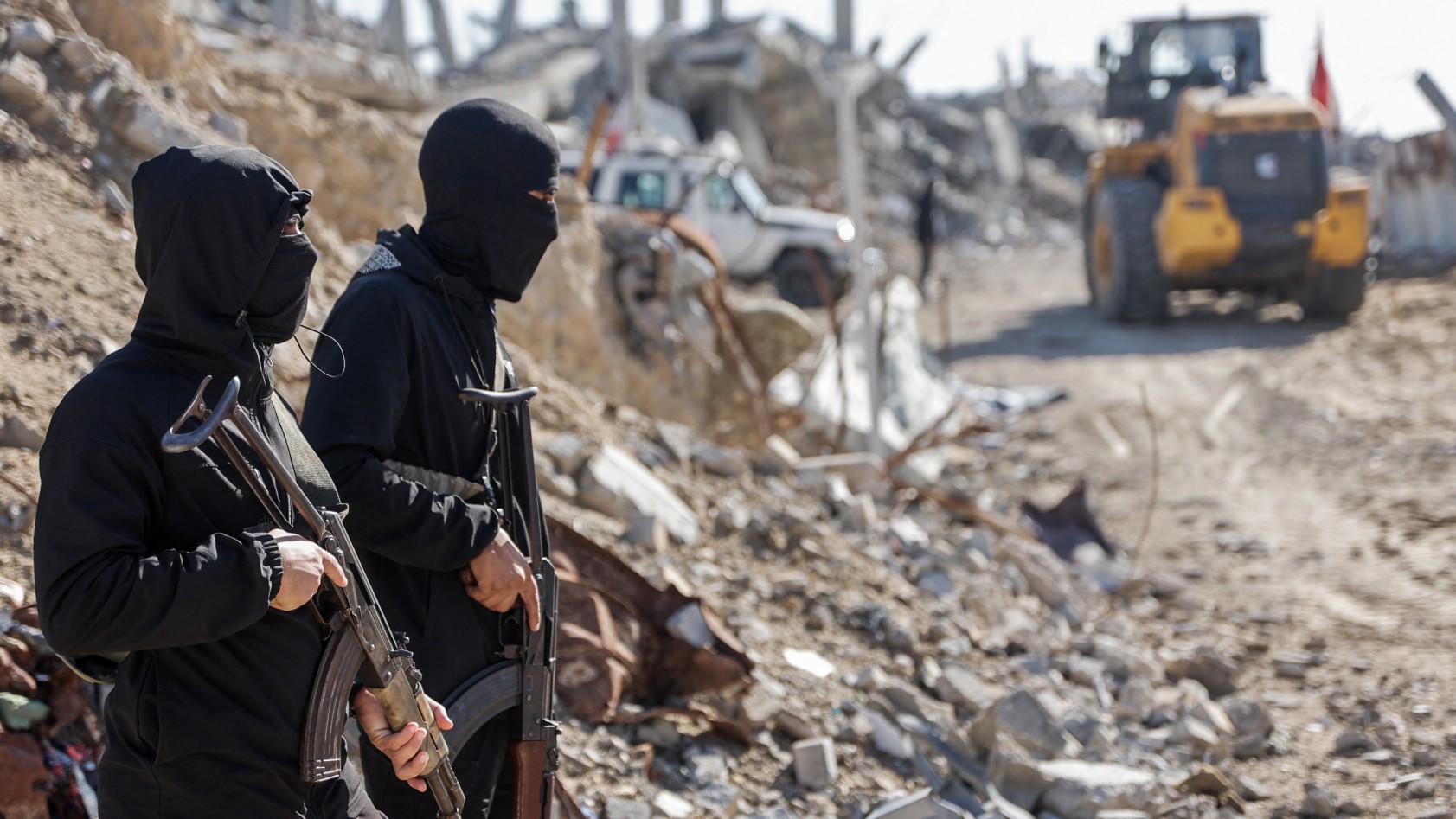
Hamas has told mediators that it is prepared to freeze all offensive operations against Israel from Gaza for up to a decade, and it is prepared to bury its weapons, if Israeli forces fully withdraw from the enclave, a senior Palestinian official familiar with the discussions told Middle East Eye.
The official, who spoke on condition of anonymity because of the sensitivity of the talks, said the offer was presented to Egyptian, Qatari and Turkish mediators in Cairo last week. The offer represents what he described as a substantive move by Hamas intended to give momentum to the next phase of the ceasefire negotiations.
“The proposal is clear,” the official said. “Hamas is offering a guarantee that no weapon will be fired from Gaza against Israel, and it will do that by burying the weapons. It offered to establish a hudna (a term used in Islamic tradition to describe a long-term truce) for seven to ten years between Gaza and Israel, and Hamas will not use the weapons.”
According to the official, the hudna would be guaranteed by the mediating states, who would act as guarantors of compliance. He said the weapons would be concealed, and that the mediators would directly supervise the commitments made by Hamas.
“During this period Gaza will be busy with itself,” the official said, referring to reconstruction and internal governance after more than two years of devastating war, displacement and siege.
New MEE newsletter: Jerusalem Dispatch
Sign up to get the latest insights and analysis on
Israel-Palestine, alongside Turkey Unpacked and other MEE newsletters
Hamas has until now refused to hand over its weapons except under the authority of a democratically elected leadership of a fully sovereign Palestinian state. The movement has repeatedly stated that its armed campaign against Israel would only end once the occupation of Palestinian land ends.
‘Of course Hamas thinks the agreement is not good. But its first priority was to stop the war’
– Senior Palestinian official
The new offer, however, concerns Gaza specifically and does not address Hamas’s military capacities or political activities in the occupied West Bank, where Israel has continued near-daily raids despite the Gaza ceasefire.
The senior official stressed that the offer was also shaped by changes in the regional diplomatic landscape, singling out Egypt for what he said was a shift in Cairo’s position in favour of the needs of Palestinians in Gaza.
Egypt, he noted, recently insisted that the Rafah crossing must allow movement in both directions, including the return of displaced Palestinians. Israel, for its part, has only permitted departures from Gaza and has blocked thousands from returning to their homes in the north and centre of the strip.
“The mediators have renewed relations with Hamas,” the official said. “Hamas found progress in the mediation and made many positive steps. The movement believes in a pragmatic way of reaching common positions.”
Truce at ‘critical stage’
At the Doha Forum on Saturday, Qatar’s prime minister and foreign minister, Mohammed bin Abdulrahman Al Thani, said the ceasefire was entering a “critical stage”, and emphasised that reopening Rafah in both directions was essential to stabilising Gaza.
“A ceasefire cannot be completed unless there is a full withdrawal of the Israeli forces,” he said, adding that people “must be able to go in and out”, which is still not possible under the current arrangements.
Since accepting the ceasefire in October, Israeli air strikes and drone attacks remain frequent. According to Palestinian authorities, more than 600 violations have been documented since the truce came into effect on 10 October, with Israel killing at least 360 people and wounding more than 900.
Israel has released thousands of Palestinian detainees as part of the ceasefire framework, but continues to hold senior figures from all major factions.
Some are reported to be held under conditions described by rights groups as starvation-level diets, imposed by far-right national security minister, Itamar Ben Gvir.

For any hope of peace, all Palestinians must be released from Israel’s torture chambers
Read More »
The senior Palestinian official defended Hamas’s decision to enter the ceasefire despite its shortcomings. He said Israeli forces remain positioned along what they call the “yellow line,” meaning Israel still occupies about 53 percent of the Gaza Strip, including some of its most productive agricultural land.
“Of course Hamas thinks the agreement is not good. But its first priority was to stop the war. Trump offered to guarantee that it ended, so Hamas accepted,” the official said.
“But there remain many things in the agreement that Hamas does not accept and which are now matters for internal dialogue among the Palestinian factions. The movement’s strategy was to stop the war and then deal with the other issues.”
Asked how long Hamas would tolerate Israeli violations of the ceasefire before responding militarily, the official conceded that the truce was at “a very difficult stage”.
“A lot of things are very bad, but our strategy is to save our people. These days are difficult, but they are just one moment in a long struggle.
“Israel will not withdraw simply because Trump demands it,” he continued. “We believe Hamas and its people can build the conditions that will force Israel to respect and concede the demands and rights of our people. The problem is not only Gaza. Israel’s strategy is to dominate the region.”
No progress on international force
Since US President Donald Trump unveiled his 20-point plan for the enclave, significant ambiguity and challenges remain regarding both the establishment of the International Stabilisation Force (ISF) in Gaza and the formation of a technocratic Palestinian government that would operate under the so-called “board of peace”.
US officials have said they expect “boots on the ground” early next year, but while countries like Indonesia have agreed to contribute troops, there is no roadmap for setting up the force, and its exact makeup, command structure and responsibilities have not been defined.
“No country is willing to provide troops without a clear idea of where they would be deployed and what their mission would be,” the official said.
“The mediators have presented ideas but nothing concrete has emerged.”

Israel-Turkey rift dampens Gaza force plans as allies get cold feet
Read More »
Asked why Hamas appeared to place so much confidence in Trump’s ability to pressure Israeli Prime Minister Benjamin Netanyahu, the official said Trump’s recent communications with Israel had signalled a rare rift.
He pointed to US special envoy Steve Witkoff’s suggestion that amnesty be offered to more than 150 Hamas fighters trapped in Rafah. Witkoff reportedly said the amnesty could serve as a “model” for the rest of Gaza.
Trump raised the issue directly with Netanyahu in a phone call. According to US officials, Trump asked why the fighters were being killed instead of allowed to surrender. Netanyahu replied that they were “armed and dangerous”.
The Palestinian official insisted that internationally, the view was shifting.
“All the capitals of the world know that the party that violated the ceasefire is Israel, not Hamas,” he said. “Hamas has done everything it committed to do. Israel is looking for a lost body in Zeitoun and cannot find it. The picture is very clear.
“We depend only on ourselves”.
Asked whether Palestinians had been abandoned once again by Arab and Muslim governments – many of which backed an agreement in Sharm el-Sheikh that avoided any reference to a Palestinian state – the official said the Palestinian people were under no illusions.
“After Allah (God), the Palestinian people depend only on themselves. The Palestinian people will not surrender or give up their struggle,” he said.
“Yes, there are many difficulties. It is not easy to force Israel to retreat. But in the end, we will reach our goals and gain our rights.”
