

Under Sheikh Ahmad Al-Abdullah, Cabinet advanced long-delayed projects, reshaped key laws
KUWAIT: In 2025, Kuwait’s government moved on multiple fronts, advancing long-delayed infrastructure projects while reshaping parts of the country’s legal and administrative framework. At the center of that effort was His Highness the Prime Minister Sheikh Ahmad Al-Abdullah Al-Ahmad Al-Sabah, who led Cabinet work spanning development projects, legal reform and international diplomacy.
Building the state
Among the most closely watched projects was Mubarak Al-Kabeer Port, a cornerstone of Kuwait’s economic ambitions. His Highness the Prime Minister oversaw key decisions on the project, including approval of direct contracting with a state-owned Chinese construction company to implement and operate the port. The effort culminated in December, when he attended the signing of the engineering, procurement, and construction contract. The move is expected to position Kuwait as a major regional logistics hub.
Transport infrastructure also advanced. HH Sheikh Ahmad Al-Abdullah inaugurated a new control tower and a third runway at Kuwait International Airport, and chaired dozens of meetings of a ministerial committee tasked with tracking major development projects. Housing and utilities were addressed in parallel. The Prime Minister led discussions on service provision for housing developments and on future electricity generation and water distillation stations.

STUTGART: HH the Prime Minister tours a Mercedes-Benz factory during a visit marking 50 years of partnership with Kuwait.

KUWAIT: HH the Prime Minister speaks at the ninth European-Gulf Business Forum.

CAIRO: HH the Prime Minister attends the opening of the Grand Egyptian Museum.

KUWAIT: Sheikh Ahmad Al-Abdullah tours the Mubarak Al-Kabeer Port construction site.

KUWAIT: Sheikh Ahmad Al-Abdullah chairs a meeting of the Supreme Defense Council in June.

HH the Prime Minister oversees work at Kuwait International Airport’s newly inaugurated control tower.

SHARM El-SHEIKH: US President Donald Trump greets Kuwait’s Prime Minister Ahmad Al-Abdullah Al-Sabah during the Sharm El-Sheikh Peace Summit.
Updating the law
Alongside construction, the Cabinet pursued a series of legislative changes aimed at modernization. In a major human rights victory, the Cabinet approved the repeal of Article 182 of the Penal Code, which previously granted kidnappers immunity from punishment if they married their victims.
To safeguard the future of the nation’s youth, His Highness the Prime Minister oversaw new laws to combat cheating and manipulation in middle and high school examinations, ensuring a fair academic environment. New measures were approved to regulate digital trade, amend civil and commercial procedures, and allow notarization through electronic or visual communication. The past year saw the implementation of digital transformation in the judiciary, allowing for electronic litigation and notarization via visual communication. After discussions led by HH Sheikh Ahmad Al-Abdullah, the Cabinet also repealed a controversial housing law that critics say unfairly granted a second chance at public housing to a select group of citizens, while thousands of others remained on waiting lists.
Governance and social policy
Nationality cases occupied a significant share of Cabinet attention. The government adopted recommendations from the the Higher Committee for the Investigation of Kuwaiti Nationality regarding citizenship withdrawal or loss in fraud-related cases. At the same time, HH the Prime Minister oversaw the creation of a grievance committee and an online platform allowing affected individuals to file appeals.
Under HH Sheikh Ahmad Al-Abdullah’s leadership, the Cabinet approved a new public debt law, setting a borrowing ceiling of KD 30 billion and permitting the issuance of financial instruments with maturities of up to 50 years. The legislation aims to diversify funding sources and reduce reliance on oil revenues. It also decided to cancel the retirees’ health insurance law, known as Afya, citing its multiple drawbacks. The Public Authority for Roads and Land Transport was abolished as part of efforts to unify administrative oversight.
Diplomacy and security
As chairman of the Supreme Defense Council, he led discussions on security developments as the Zionist entity attacked the region in June. Internationally, HH the Prime Minister led Kuwait’s delegation to several high-profile gatherings. He represented His Highness the Amir Sheikh Meshal Al-Ahmad Al-Jaber Al-Sabah at the Sharm El-Sheikh Peace Summit and the opening of the Grand Egyptian Museum.
Throughout 2025, His Highness the Prime Minister Sheikh Ahmad Abdullah Al-Ahmad Al-Sabah held a series of high-level meetings with international leaders, heads of global organizations, and corporate executives as part of Kuwait’s diplomatic and development agenda. He received the Egyptian Prime Minister, Mostafa Madbouly in February, met Sheikh Mansour bin Zayed Al Nahyan during his visit to Kuwait in June and later hosted UAE Minister of State for Artificial Intelligence Omar Sultan Al Olama in November.
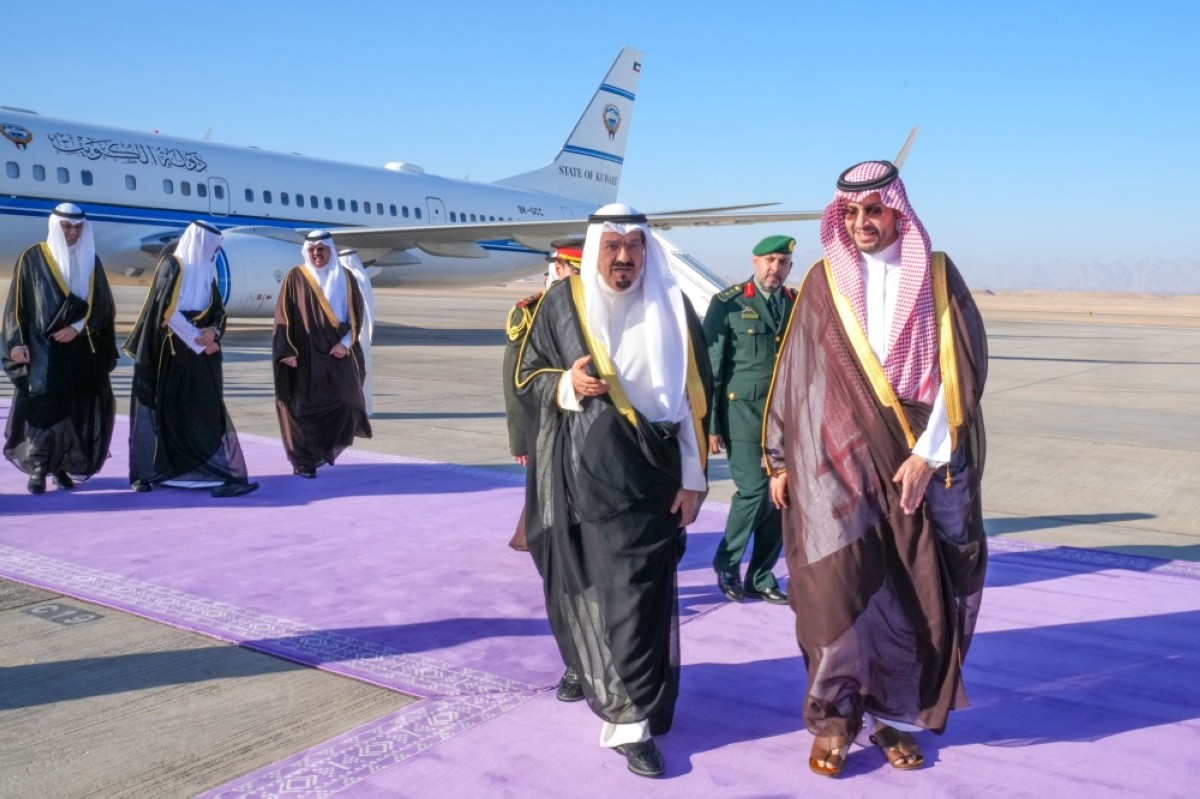
The Prime Minister also welcomed Vietnamese Prime Minister Pham Minh Chinh in November, received Japanese Foreign Minister Iwaya Takeshi during the GCC–Japan strategic dialogue and conducted an official visit to Saudi Arabia in August, followed by talks with Prince Turki Al-Faisal bin Abdulaziz Al Saud on academic cooperation. On the multilateral front, he met International Monetary Fund Managing Director Kristalina Georgieva in October and the Fund’s Middle East and Central Asia director, Jihad Azour, in December, and received European Union foreign policy chief Kaja Kallas during the ninth European-Gulf Business Forum.
His engagements also included meetings with UN High Commissioner for Refugees Filippo Grandi and a delegation from the Organization for Economic Co-operation and Development. Representing His Highness the Amir, HH the Prime Minister also traveled to Germany to meet Mercedes-Benz Group officials marking 50 years of partnership. — Agencies
