

The capture of Nicolás Maduro by American special forces has provided the world with its most jarring image of the new Washington realism. For the Trump administration, the pre-dawn raid in Caracas is a matter of law enforcement and hemispheric security. For Beijing, the event is being framed not through the lens of a personal rivalry but as a defining moment for the international order.
While the immediate reaction from the Chinese foreign ministry was a predictable condemnation of “hegemonic acts,” a closer look at China’s behavior reveals a response that is strikingly pragmatic and legally focused.
China is currently performing a delicate diplomatic balancing act. It has signaled that its primary interest is not the restoration of a fallen strongman but the preservation of a stable, predictable global system in which sovereignty remains the ultimate currency.
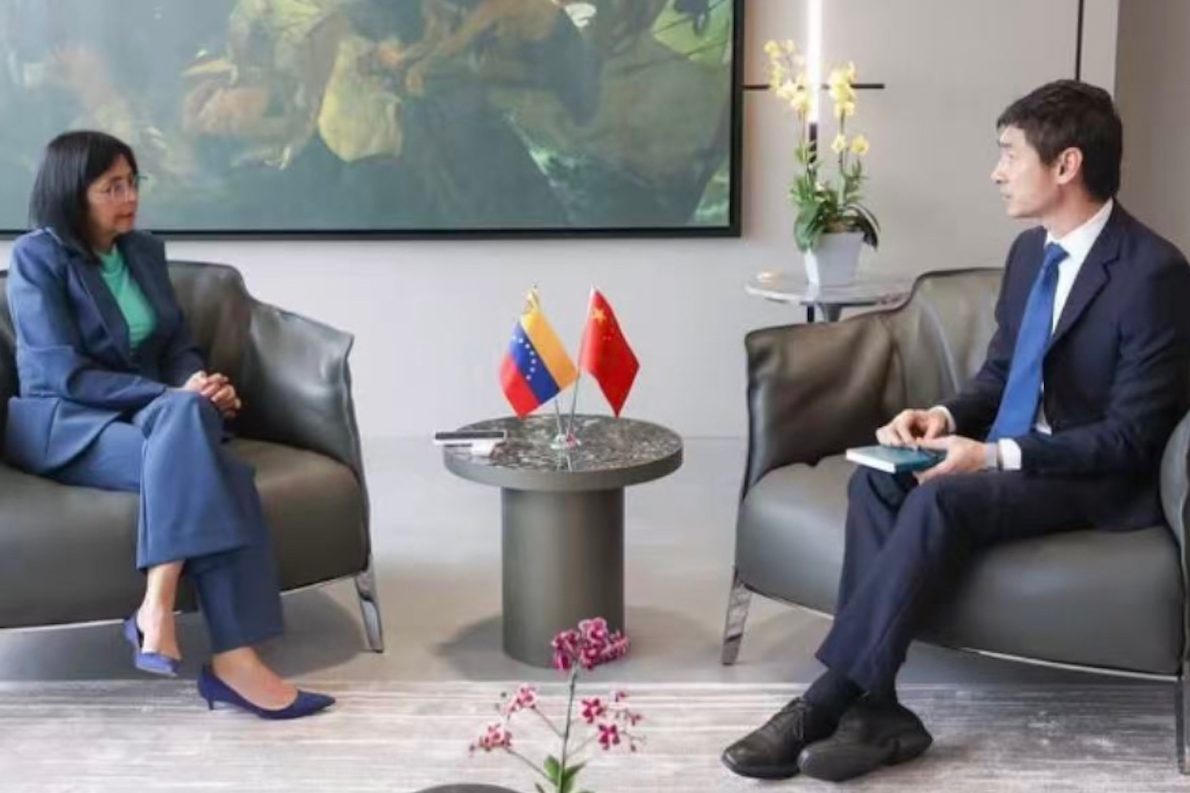
By Tuesday evening, Beijing had already indicated its willingness to work with the interim administration of Delcy Rodríguez, provided that the transition remains rooted in Venezuelan law. (China’s Ambassador Lan Hu then met with the acting president in Caracas on Thursday.)
This reveals a China that is less interested in ideological confrontation and more concerned with being the “adult in the room”—the power that prioritizes continuity, debt repayment and the rule of law over the volatility of sudden regime change.
The economic stakes for Beijing are considerable. With over $60 billion in loans funneled into Venezuela since 2007, China is the nation’s largest creditor. In the old era of geopolitics, such a massive investment might have prompted a more aggressive defense of the incumbent. Instead, China is using its influence to position itself as a stabilizing force.
By emphasizing that its “lawful interests” must be protected regardless of who occupies the Miraflores Palace, Beijing is sending a message to Washington: China is a stakeholder in the global economy that values commercial stability above political personalities.
There is also a significant soft-power dimension to Beijing’s restraint. As the United States adopts a more interventionist posture that’s hemispheric-first, China is positioning itself as the champion of the United Nations Charter.
This is a deliberate appeal to the Global South. While Washington is seen to be acting unilaterally, Beijing is calling for the Security Council to take the lead. This allows China to present an alternative vision of global leadership—one that offers infrastructure and loans rather than airstrikes and extraditions.
For many nations in Southeast Asia, Africa, and even Latin America, the Chinese insistence on non-intervention is an attractive contrast to the perceived unpredictability of American power.
Critically, the Chinese response suggests a desire to avoid an escalatory spiral with the United States. Despite the rhetoric of “hegemony,” there has been no move toward retaliatory sanctions or military posturing. Instead, the focus has remained on the safety of Chinese personnel and the continuity of oil exports.
This pragmatism is a sign of a mature superpower that understands its limitations and its priorities. China realizes that a total collapse of the Venezuelan state would serve nobody’s interest, least of all its own. By facilitating a dialogue within the framework of the Venezuelan constitution, China is offering a path toward stability that could actually complement American goals of regional order, even if the two powers disagree on the methods used to achieve it.
The capture of Maduro has certainly tested China’s “global security initiative,” which emphasizes diplomacy over force. However, rather than viewing the event as a defeat, Beijing is using it as an opportunity to demonstrate its own diplomatic indispensability.
It is significant that, while Russia has called for the immediate reinstatement of Maduro, China has shifted its focus to the “arrangements made by the Venezuelan government.” This suggests that Beijing is prepared to accept a post-Maduro reality as long as it does not set a precedent for lawlessness.
In the long term, China’s response to the Caracas raid may redefine its role in the Western Hemisphere. By refusing to be baited into a Cold War-style proxy conflict, Beijing is proving that it can be a responsible, if critical, participant in global affairs. The transition from an age of ideology to an age of realpolitik can be messy, but China’s current trajectory suggests it is well-equipped to navigate this shift.
If the United States intends to “run” Venezuela and its oil reserves, as the White House has suggested, it will eventually have to sit across the table from Caracas’s largest creditor. When that moment comes, Washington may find that a pragmatic China, focused on legal frameworks and economic stability, is a more useful partner than a defensive one.
The raid in Caracas was a display of American hard power, but the ensuing weeks will likely be a master class in Chinese soft power.
