

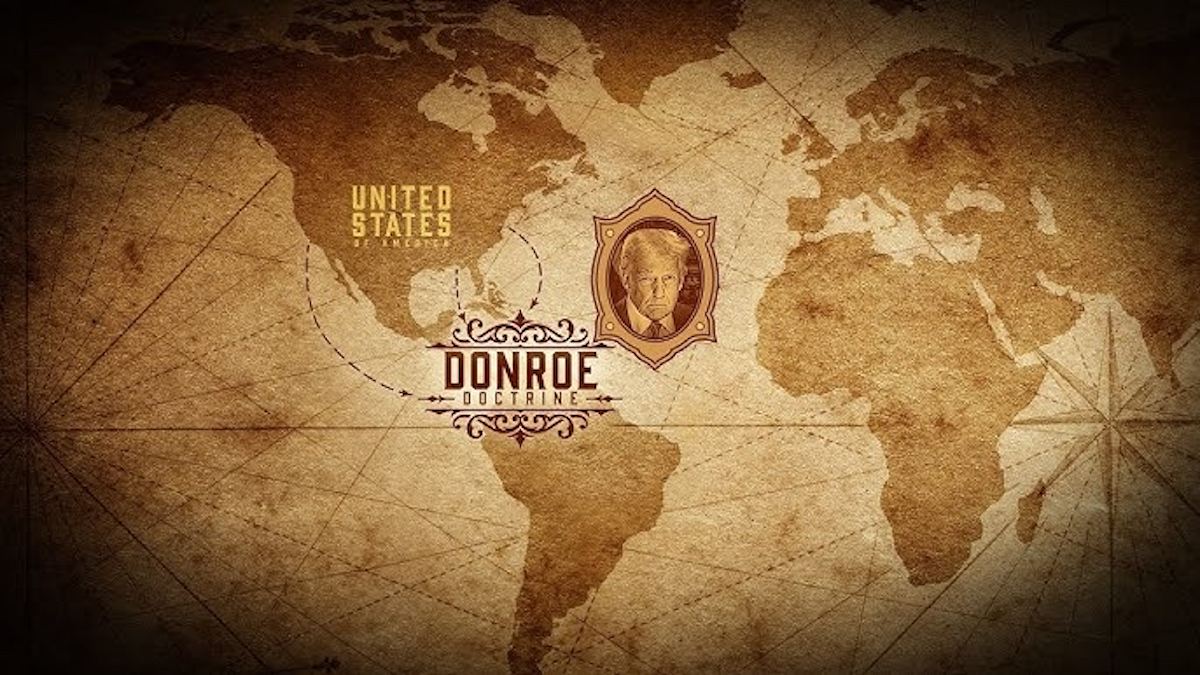
Trump’s bid to dominate the Western Hemisphere and seize Greenland is not just a Latin American or North Atlantic story. It is an experiment in 19th-century spheres of influence in a 21st-century, deeply interconnected world.
For Beijing and the wider Asian region, the question is whether this “Donroe Doctrine” becomes a bargaining chip over Asia—or a template others feel entitled to copy.
Trump’s so-called Donroe Doctrine takes the old Monroe Doctrine—no outside powers in the Americas—and adds an explicit Trump Corollary: the United States will “reassert and enforce” hemispheric preeminence and deny non-hemispheric competitors control of key assets in the region.
In practice, this has meant threats to seize the Panama Canal, take control of Greenland, rename the Gulf of Mexico the “Gulf of America” and the deployment of large military forces and economic coercion across Latin America.
By openly declaring that Washington now “runs” Venezuela after the seizure of Nicolás Maduro, Trump has framed the hemisphere as a US protectorate rather than a community of sovereign states. European officials already describe this as a return to “imperial” thinking.
But many also worry that a US fixated on its own hemisphere will leave vacuums in Europe and Asia that China and Russia can fill.
Trump’s renewed insistence that the US must “take” Greenland—”the easy way or the hard way”—is justified in Washington as a move to block Chinese and Russian ships and bases in the Arctic and North Atlantic.
Greenland’s rare-earth deposits, potential energy resources and its position astride emerging Arctic shipping routes make it a strategic hinge between North America, Europe and the shorter sea lanes linking Asia to Europe.
Beijing, which has called itself a “near-Arctic state,” has invested in Arctic energy, research stations and a Polar Silk Road that would cut shipping times to Europe roughly in half. It has pursued projects and planned facilities in Greenland itself.
A forcible or coerced US takeover of Greenland would not only threaten those interests. It would also harden China’s perception that Washington seeks to militarize the Arctic and close off yet another avenue of global connectivity that benefits Asian trade.
From Beijing’s vantage point, Trump’s hemispheric focus is deeply ambiguous.
On the one hand, if Washington concentrates resources on policing Latin America and the Caribbean—and bullying partners like Canada and Mexico with tariffs—it may have fewer dollars and diplomats to sustain a constant confrontation in the Western Pacific.
On the other hand, US moves to push Panama out of the Belt and Road, to isolate Venezuela and Cuba, and to threaten military action in the hemisphere are clearly aimed at rolling back Chinese economic and political influence across the Americas.
Some Chinese strategists appear intrigued by the idea of mutual spheres of influence: greater deference to US dominance in the Americas in exchange for more US restraint on flashpoints in the Western Pacific.
Yet the Venezuelan episode—where China and Russia, despite deep investments, could not prevent Maduro’s capture—also exposes the risks of overextension and the limits of extra-regional power projection against a determined hegemon on its home turf.
For Asian allies and partners, Trump’s Western Hemisphere project is a stress test of US reliability, not just its power.
If Washington tells Europe and East Asia to “pick up the slack” while it prioritizes its own backyard, Asian capitals will have to assume more responsibility for their own deterrence, especially in maritime domains from the Indian Ocean to the Philippine Sea.
At the same time, a prolonged clash with Denmark and NATO over Greenland could fracture trans-Atlantic cohesion, indirectly weakening the broader Western coalition that underpins US strategy in the Indo-Pacific.
Asian middle powers—Japan, India, South Korea, Australia and ASEAN states—thus face three overlapping tasks. First, reduce over-dependence on US security guarantees by accelerating indigenous defense and minilateral cooperation.
Second, engage Latin America and the Arctic as genuine strategic theaters, not distant peripheries—especially on energy, rare earths and shipping rules. Third, quietly resist any great-power carve-up that trades away principles in one region in exchange for deference in another.
The unorthodox feature of Trump’s Donroe Doctrine is not that it asserts primacy in the Americas—that is as old as Monroe—but that it tries to revive territorial spheres of influence in a world where supply chains, finance and data flows are structurally non-hemispheric.
Latin America’s trade is deeply integrated with China. Greenland’s minerals and Arctic routes are central to Asia-Europe commerce. US sanctions or military moves in one “sphere” ricochet through global markets in real time.
For China and the rest of Asia, the real danger is not simply a stronger America in its own neighborhood. It is a normalized logic in which all great powers claim geographic veto rights while remaining fully embedded in each other’s economic systems.
An Asia-Pacific perspective that treats Trump’s Western Hemisphere ambition and his Greenland gambit as parts of a single experiment in managed fragmentation—one that others could emulate—allows the region to respond not with reflexive alignment or opposition, but with a deliberate effort to preserve openness where it matters most.
That means protecting the flows of trade, technology and capital that no border—and no hemisphere—can truly contain.
Y. Tony Yang is an endowed professor at the George Washington University in Washington, DC.
