

Gulf’s harvest in 2025: Two summits, prominent role in reshaping global landscape
KUWAIT: As 2025 draws to a close, the Gulf Cooperation Council (GCC) states mark a year defined by pivotal developments and strategic milestones that reinforced Gulf unity, regional stability and global engagement. The year witnessed the convening of two GCC summits, including an extraordinary session, reflecting a shared belief in common destiny and unity of purpose, alongside sustained diplomatic efforts that contributed to ending a devastating war in Gaza that lasted nearly two years.
Building on the momentum of previous years, GCC countries in 2025 continued to consolidate their strategic position at the heart of global geopolitical and economic transformations. This was achieved through the expansion of strategic partnerships with international powers and leadership in high-quality investment in future-oriented sectors. Throughout the year, the GCC advanced key initiatives aimed at accelerating development, deepening economic integration, strengthening collective security and playing a more active role in political decision-making and complex mediation efforts.
In a decisive security and political response to regional developments, Doha hosted an emergency Arab and Islamic Summit and an extraordinary GCC Summit following Qatar’s response to an unprecedented Iranian attack on Al Udeid Air Base last September. The extraordinary GCC Summit affirmed full solidarity with Qatar and tasked the Unified Military Command with implementing joint defense mechanisms and strengthening Gulf deterrence capabilities.

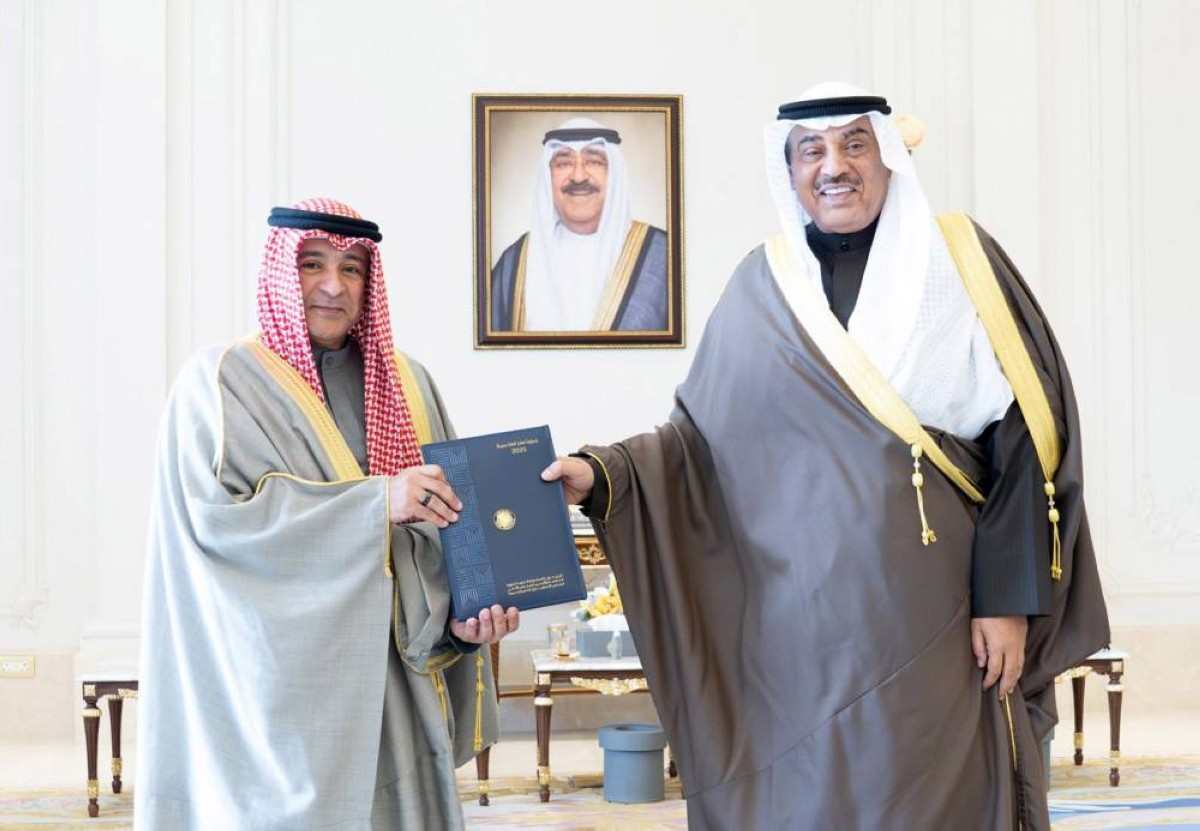
KUWAIT: His Highness the Prime Minister Sheikh Ahmad Abdullah Al-Ahmad Al-Sabah received Secretary General of the Gulf Cooperation Council (GCC) Jassem Al-Budaiwi on Sunday at Bayan Palace. During the meeting, Al-Budaiwi presented His Highness the Prime Minister with a report on Kuwait’s presidency of the 45th session of the GCC Supreme Council. The meeting was attended by Head of the Prime Minister’s Diwan Abdulaziz Al-Dakhil.- KUNA
The Joint Defense Council approved measures to enhance intelligence sharing, accelerate work on the joint ballistic missile early warning system and update collective defense plans in coordination with GCC military and operational bodies. These outcomes were reinforced at the 46th Ordinary GCC Summit, held in Bahrain in early December, which reflected a growing Gulf drive to enhance joint security and deepen integration across multiple sectors.
The summit’s final statement reaffirmed the outcomes of the extraordinary session and the emergency Arab-Islamic Summit held in Doha on September 15, 2025, stressing the full and continuous implementation of the vision of the Custodian of the Two Holy Mosques to strengthen joint Gulf action, including completing economic unity and joint defense and security systems.
Among its key decisions, the summit approved the gradual activation of the customs data exchange platform in the second half of 2026, the establishment of a GCC Civil Aviation Authority headquartered in the UAE, and the adoption of the general agreement linking GCC states through the regional railway project. It also called for accelerating action plans with strategic partners following joint summits with the United States, the European Union, ASEAN and China.
During 2025, GCC states hosted and participated in numerous high-level summits and conferences, including the Gulf-US Summit in Riyadh attended by GCC leaders and US President Donald Trump, as well as an expanded Arab-international ministerial meeting on Syria. Gulf diplomacy further diversified through enhanced engagement with Russia, highlighted by the eighth GCC-Russia Strategic Dialogue meeting held last September.
Economically, GCC countries advanced their forward-looking vision by prioritizing digital transformation and technological innovation, positioning the region as a global hub for major international gatherings. Key events included the World Government Summit 2025, the International Mining Conference, the Future of Real Estate Forum, the International Labor Market Conference, the Islamic Finance Conference and the Arab Media Summit. Saudi Arabia hosted LEAP 2025, the region’s largest technology conference, announcing investments and launches worth $14.9 billion, while the UAE signed a framework agreement to invest around €50 billion in an artificial intelligence data center in France.
The GCC also reaffirmed its unwavering support for the Palestinian cause through a comprehensive strategy combining active diplomacy, mediation and humanitarian assistance. Gulf states participated in a series of high-level initiatives, including the Arab Summit on Palestine, the ministerial committee formed by Arab and Islamic summits, and the international conference on a peaceful settlement of the Palestinian question and the two-state solution.
They also contributed to launching the Emergency Alliance for the Financial Sustainability of the Palestinian Authority and joined a collective Arab-Islamic statement condemning Zionist legislation aimed at imposing sovereignty over the occupied West Bank and settlements. The 46th GCC Summit underscored the centrality of the Palestinian cause, called for an end to the Zionist occupation and blockade of Gaza, and reaffirmed support for the establishment of an independent Palestinian state within the 1967 borders.
Kuwait’s statement on behalf of the GCC at an emergency UN Security Council session reiterated that lasting peace can only be achieved through a two-state solution based on international legitimacy and the Arab Peace Initiative. Gulf mediation efforts in 2025 extended beyond the region. The UAE played a leading role in facilitating prisoner exchanges between Russia and Ukraine and between the United States and Russia. Qatar contributed significantly to ceasefire efforts in Gaza, while Oman facilitated dialogue between Washington and Tehran and helped broker understandings involving Yemen.
Saudi Arabia hosted high-level talks between the foreign ministers of Russia and Ukraine, the first such meeting since the outbreak of the war in 2022. GCC states also supported Syria’s reintegration into its regional and international environment and continued mediation efforts in Africa and beyond. International recognition of the GCC’s role was reflected in the UN General Assembly’s adoption of a resolution on cooperation between the United Nations and the GCC, underscoring the Council’s standing as a key regional partner for peace and security.
Internally, the GCC advanced integration through executive measures and bilateral agreements, including the establishment of the Kuwaiti-Saudi Coordination Council, the entry into force of an investment protection agreement between Bahrain and the UAE, and a Qatari-Saudi memorandum on media and sports cooperation. Economic coordination featured prominently at the 43rd Gulf Development Forum and the 124th meeting of the Financial and Economic Cooperation Committee, while the GCC Secretariat approved the establishment of a permanent Gulf Youth Council and an annual youth–decision-makers dialogue forum. Trade and industrial integration progressed through meetings of the Trade Cooperation Committee and the Industrial Cooperation Committee, which approved the launch of the first unified Gulf industrial platform and plans for a “Made in the Gulf” forum and exhibition in 2026.
These developments have enhanced the region’s international economic outlook. The World Bank projects GCC economic growth of around 4.5 percent by 2026, driven by diversification, non-oil growth, infrastructure investment and tourism development. The year also saw the signing of multiple agreements covering energy, transport, logistics, taxation and investment, alongside new defense cooperation agreements. Humanitarian engagement remained a cornerstone of Gulf policy, with GCC states intensifying aid to Palestine, Syria and Sudan. Between 2020 and 2025, the GCC provided $14 billion in official humanitarian assistance, ranking as the world’s fourth-largest donor bloc.
In parallel, GCC countries expanded cooperation in education, research, innovation and digital transformation, while the region further strengthened its global presence in sports by hosting major international events, including world championships and regional tournaments. Together, these achievements underscore a year in which the GCC consolidated its unity, expanded its influence and reinforced its role as a dynamic and responsible actor on the regional and global stages. — KUNA
