


He may be in his third season at Old Trafford, but it finally seems that Manchester United fans are starting to see the best of Mason Mount.
Question marks were raised when Erik ten Hag paid £55 million for the then-maligned Chelsea star, especially given his fitness concerns and lack of obvious role in the Dutchman’s system.
After early struggles, he seems to have found his feet under Ruben Amorim. Earmarked as an early favourite of the Portuguese, he currently finds himself on his most consistent run in the team at the Theatre of Dreams, already equalling his previous best seasonal goals tally at the club.

Mason Mount spoke to Sky Sports about his role in Ruben Amorim’s team after Man Utd’s 4-1 win over Wolves
For many, Mount has become a focal point in how Amorim wants his United side to play. They clearly get better results when he is in the team – the Red Devils have lost just once in the Premier League when he starts, compared to three times when he doesn’t. But the numbers show that doesn’t necessarily equate to better performances.
Ahead of what could prove to be a season-defining test against Villa Park on Sunday, live on Sky Sports, how exactly do United alter their ways with the 26-year-old in the team?
Quality over quantity – Mount making United more efficient, not dominant
Amorim has often insisted that it doesn’t matter in what formation his teams line up in. What matters is the finer details as to how the players operate within it.
“The most important thing is to create the principles, the identity and the character that we had in the past. We need time, but we have to win time. To win time is to win games. But the most important thing is identity,” were his exact words when he was first hired in November 2024.
Sunday 21st December 3:30pm
Kick off 4:30pm


While he hasn’t spoken out on the specifics of what those principles are, history shows that Amorim’s teams focus on a possession-based style built around shorter passes and a high defensive line that enables an assertive pressing approach.
On the surface, that sounds like a way of playing that would suit Mount’s strengths. Yet when he is in the team, those characteristics seem to falter.
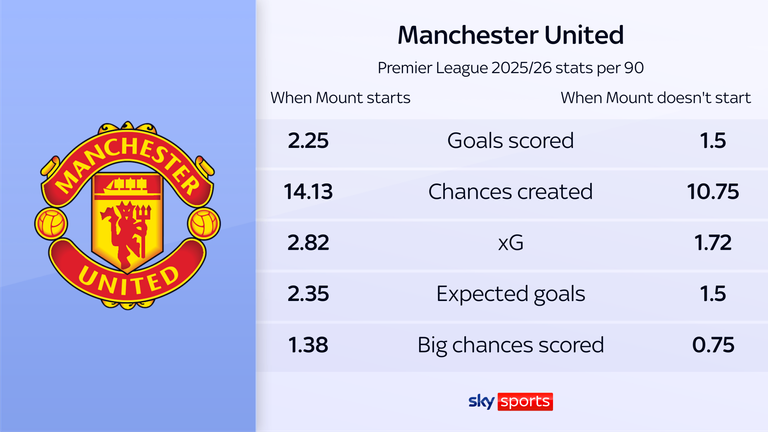
It has been a 50/50 between games started and games where the Englishman has either come off the bench or not featured. When he starts, United not only pick up more points, but they score more goals (2.25 per game vs 1.50) and are far more efficient when finishing their ‘big’ chances (1.38 goals vs 0.75).
That points towards a positive impact, which can’t be denied. Look further though, and you see that with Mount in the team, United tend to move further away from the fundamentals associated with Amorim.
Though the number of chances created when Mount starts is significantly higher, the number of ‘big chances’ is lower, suggesting that United have far more low xG efforts built up in these games, rather than creating clearer goalscoring opportunities more frequently.
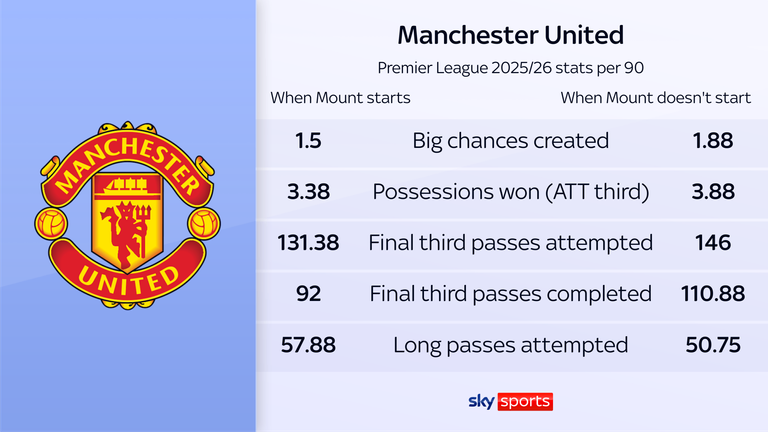
Some of this lack of higher-quality chances can perhaps be attributed to the fact that there is also a major shift towards a more direct style of play when Mount starts compared to when he doesn’t.
With him in the team, United average more long passes. They also attempt 10 per cent fewer passes in the final third and pull off 17 per cent less.
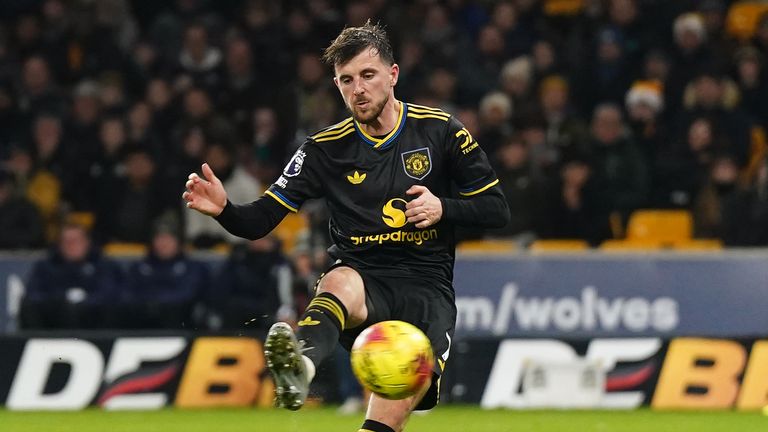
Mason Mount has already equalled his best goals tally in a season at Manchester United
Perhaps most surprisingly, in games where Mount starts, United win possession back in their attacking third less too. Given that the narrative is that Mount’s energy aids United in the press, you’d expect the opposite to be the case.
That is not to say that Mount is the sole reason for the drop-offs.
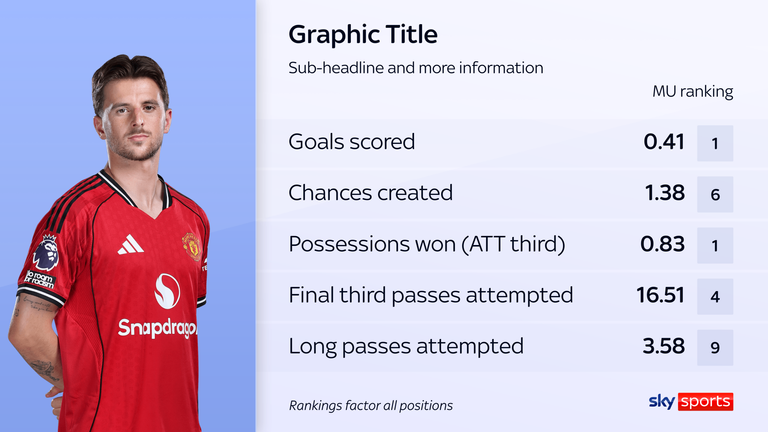
As an individual, he ranks sixth in the team in chances created, fourth in final third passes attempted and completed, only ninth in long passes and second in possession won in the attacking third among the squad.
By those metrics, you can see that he is doing what you would expect him to do based on Amorim’s requirements. Yet, as a collective, United are moving away from Amorim’s principles more often when Mount is in the team.

Speaking after Manchester United’s 4-4 draw with Bournemouth in the Premier League, Gary Neville claims that Ruben Amorim got the right players on the pitch after going 3-2 down
Is that a criticism? If anything, it’s the opposite. Much has been said of Amorim’s reluctance to adapt his way of playing in order to find success, but the data proves that there is flexibility to be played with.
It is more interesting though that a player who was believed to be the epitome of what Amorim needed from his squad has highlighted that his success is coming when he steers away from the methodology that he was so steadfast in bringing to Old Trafford.
